
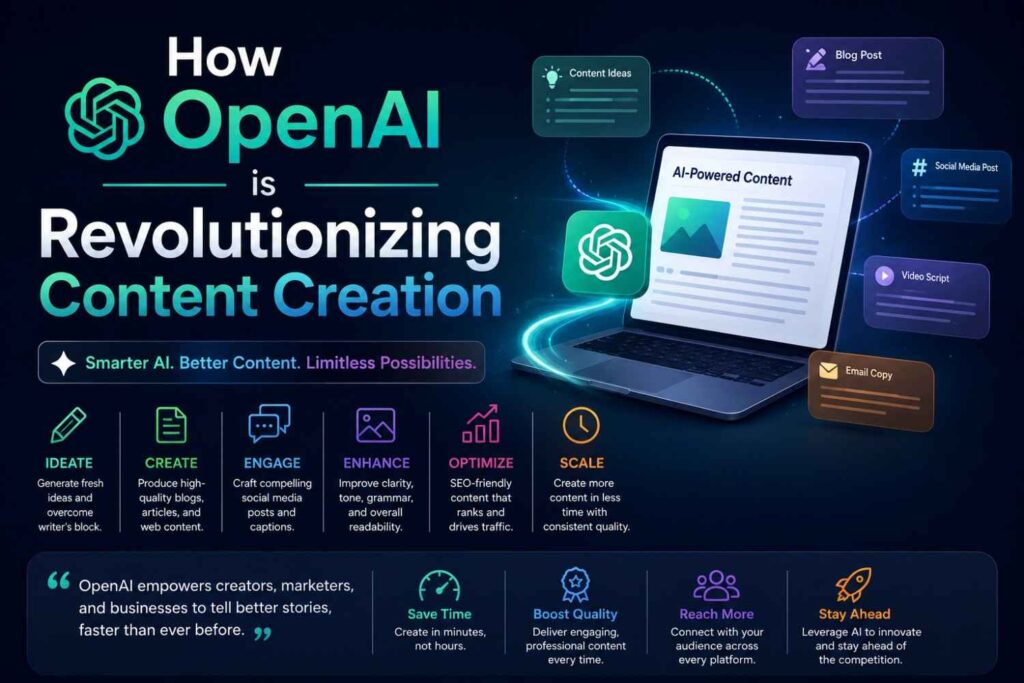
Content creation has changed more in the last few years than it did in the previous decade. Writers, marketers, designers, agencies, and business owners are no longer creating every idea, draft, image, caption, script, and campaign from scratch. They now have AI tools that can help them plan, write, edit, design, research, and repurpose content faster.
That is why the topic How OpenAI is Revolutionizing Content Creation is so important today. OpenAI tools such as ChatGPT, GPT models, image generation, and Sora-style video generation are helping creators move from slow manual production to faster, smarter, and more scalable content workflows.
But this revolution is not only about speed. It is also about creativity, personalization, accessibility, and better use of data. OpenAI can help a small business create professional marketing content, help an agency manage multiple campaigns, and help enterprise teams produce brand-safe content at scale.
In this article, I will explain How OpenAI is Revolutionizing Content Creation in a practical and professional way. I will cover writing, SEO, images, video, social media, brand voice, AEO, GEO, workflow automation, risks, and future trends.
What Makes OpenAI Different in Content Creation
OpenAI is different because it combines language understanding, reasoning, image generation, code support, and workflow automation in one growing ecosystem. Traditional content tools usually focus on one task. OpenAI can support the full content lifecycle, from idea to final publishing draft.
OpenAI Understands Context, Not Just Keywords
Older writing tools often worked by matching keywords or templates. OpenAI models can understand instructions, tone, audience, format, structure, and intent. This means a user can ask for a blog introduction, a LinkedIn post, an email sequence, a product description, or a video script with specific style guidelines.
For example, a brand can ask OpenAI to write content for a beginner audience, use simple language, avoid technical jargon, and include a strong call-to-action. This makes AI content creation more flexible and useful for real marketing teams.
OpenAI Supports Multiple Content Formats
OpenAI is not limited to text. It can support written content, image prompts, visual concepts, code, data analysis, research summaries, campaign planning, and video ideation. OpenAI’s image generation tools can create and edit visuals from text prompts, while Sora is designed for text-to-video generation.
This matters because modern content marketing is not only blogging. Brands need website copy, ads, graphics, reels, newsletters, landing pages, case studies, scripts, and short-form social content.
OpenAI Helps Teams Work Faster Without Starting from Zero
One of the biggest benefits is removing the blank-page problem. A writer can ask for an outline. A designer can ask for visual direction. A marketer can ask for ad variations. A business owner can ask for a product launch plan.
OpenAI does not replace human creativity. It gives people a starting point, structure, and creative options. The best results still come when humans add brand voice, experience, emotional intelligence, and fact-checking.
How OpenAI is Revolutionizing Content Creation for Writers and Marketers
How OpenAI is Revolutionizing Content Creation can be seen most clearly in writing and marketing workflows. It helps teams create more content, test more ideas, and improve content quality with less manual effort.
Faster Blog Writing and Long-Form Content Planning
OpenAI can help writers create topic ideas, outlines, introductions, subheadings, meta titles, FAQs, and full draft structures. This is useful for SEO blogs, thought leadership articles, product guides, comparison pages, and educational content.
A strong AI-assisted blog workflow looks like this:
| Step | Human Role | OpenAI Role |
|---|---|---|
| Topic research | Choose audience and business goal | Suggest angles and search intent |
| Outline | Approve structure | Generate H2 and H3 ideas |
| Drafting | Add expertise and examples | Create first draft sections |
| Editing | Check quality and accuracy | Improve clarity and flow |
| SEO | Confirm keywords and links | Suggest meta data and FAQs |
This process saves time while keeping the writer in control.
Better Ad Copy, Emails, and Landing Pages
Marketing teams can use OpenAI to create multiple versions of ad headlines, email subject lines, landing page sections, product descriptions, and call-to-action copy. Instead of writing one campaign message, they can test many angles quickly.
For example, an ecommerce brand can ask for ad copy focused on price, quality, urgency, trust, or benefits. A B2B company can ask for copy targeted to CEOs, marketing managers, or operations teams. This makes AI marketing automation more practical and personalized.
Stronger Editing, Rewriting, and Repurposing
OpenAI can rewrite content for different channels. A 1500-word blog can become a LinkedIn post, email newsletter, Instagram caption, YouTube description, or short video script.
This is powerful because content teams often do not need more ideas. They need better systems for repurposing what they already have. OpenAI helps turn one strong asset into many useful content formats.
How OpenAI Improves SEO, AEO, and GEO Content Strategy
SEO is changing because users now search on Google, Bing, AI assistants, social platforms, and answer engines. That is why content needs to be optimized not only for search engines, but also for AEO and GEO.
SEO Content Becomes More Structured and Intent-Focused
OpenAI can help identify search intent, secondary keywords, cluster keywords, heading structures, and FAQ ideas. It can also create content briefs that help writers cover a topic more completely.
Good SEO content today needs:
- Clear search intent
- Helpful headings
- Natural keyword usage
- Internal links
- External trusted sources
- FAQs
- Original examples
- Clear answers near the top
OpenAI helps organize these elements, but human review is still needed to avoid generic or inaccurate content.
AEO Helps Content Answer Questions Clearly
AEO stands for Answer Engine Optimization. It focuses on creating direct, clear answers that can appear in featured snippets, voice search, and AI answer results.
OpenAI can help create concise answers, FAQ sections, step-by-step explanations, definitions, and comparison tables. For example, instead of writing a vague paragraph about AI content creation, a page can include a direct answer like: “AI content creation is the process of using artificial intelligence tools to plan, write, edit, design, and repurpose digital content.”
GEO Helps Content Become AI-Search Friendly
GEO stands for Generative Engine Optimization. It focuses on making content easy for AI systems to understand, summarize, and reference. This means content should be factual, well-structured, source-backed, and written with clear entities.
OpenAI helps with GEO by creating clean topic clusters, entity-rich headings, natural question-answer sections, and summaries. However, to perform well in AI-driven search, brands still need original insights, trusted sources, expert quotes, and real-world examples.
OpenAI for Visual, Video, and Social Media Content
Content creation is no longer only about writing. Visuals, short videos, carousels, and social posts are now essential for audience engagement. OpenAI is helping creators speed up visual and multimedia planning.
AI Image Generation for Creative Campaigns
OpenAI’s image generation tools allow users to create and customize visuals using natural language prompts. Businesses can use this for campaign concepts, product mockups, social media graphics, website hero images, ad visuals, and creative direction.
For example, a fashion brand can generate mood board concepts. A software company can create clean SaaS-style illustrations. A local business can test different promotional design ideas before hiring a designer for final production.
AI Video Generation and Script Planning
OpenAI’s Sora is designed to generate video from text instructions. This creates new possibilities for marketers, educators, filmmakers, and social media teams. Even when a team is not generating final videos directly, OpenAI can still help with video scripts, scene planning, shot lists, hooks, captions, and storyboards.
Video content usually takes more time and budget than written content. AI can reduce planning time and help teams test creative ideas before production.
Social Media Content at Scale
OpenAI can generate social media calendars, post captions, hooks, hashtag ideas, carousel outlines, reel scripts, and comment responses. This helps businesses stay consistent on platforms like LinkedIn, Instagram, Facebook, TikTok, and X.
A simple social content table can look like this:
| Platform | OpenAI Content Support | Example Output |
|---|---|---|
| Thought leadership posts | Industry insight post | |
| Captions and reels | Product promotion caption | |
| Local ads and updates | Offer-based post | |
| TikTok | Short scripts | 20-second video hook |
| YouTube | Titles and descriptions | SEO-friendly video description |
Business Benefits of OpenAI in Content Creation
The main reason businesses care about How OpenAI is Revolutionizing Content Creation is simple: it can improve productivity, reduce bottlenecks, and help teams create better content systems.
Faster Production and Lower Content Bottlenecks
Many teams struggle because content work depends on a few people. Writers wait for briefs. Designers wait for copy. Marketing managers wait for campaign ideas. OpenAI helps remove delays by creating first drafts, outlines, ideas, and variations quickly.
This does not mean businesses should publish AI output without review. It means teams can spend less time on rough drafts and more time on strategy, accuracy, creativity, and conversion.
More Personalization for Different Audiences
OpenAI can help personalize content for different audiences, industries, locations, buyer stages, and customer needs. A business can turn one service page into versions for startups, enterprises, local customers, or industry-specific buyers.
Personalization improves relevance. For example, a cybersecurity company can explain the same service differently to a CEO, IT manager, and compliance officer. OpenAI makes this easier at scale.
Improved Collaboration Across Teams
OpenAI can act as a shared content assistant for marketing, sales, product, HR, and customer support teams. Sales teams can request battle cards. Product teams can summarize customer feedback. HR teams can create training content. Support teams can turn tickets into help articles.
This creates a more connected content ecosystem where knowledge moves faster across the business.
Risks, Limitations, and Best Practices for AI Content Creation
AI content creation has strong benefits, but it also has risks. A professional content strategy should use OpenAI responsibly, with human review and clear quality standards.
Fact-Checking Is Still Essential
OpenAI can generate confident-sounding answers, but AI output can still be wrong, outdated, or incomplete. Writers should verify statistics, legal claims, pricing, medical information, financial claims, product details, and technical statements with trusted sources.
A simple rule is: never publish a factual claim unless it has been checked. If exact data is not available, use [FACT NEEDS VERIFICATION] or [SOURCE NEEDED].
Brand Voice Must Stay Human
AI can imitate tone, but it does not automatically understand a brand’s real values, customer stories, or market position. Brands should create AI brand voice guidelines that include preferred tone, banned phrases, audience details, formatting rules, and examples of approved content.
This keeps AI-generated content from sounding generic.
Originality and Ethics Matter
Businesses should avoid using AI to copy competitors, imitate living artists directly, spread misinformation, or publish low-quality mass content. AI should support originality, not replace it.
Best practices include:
- Add human experience
- Use verified sources
- Edit for originality
- Avoid misleading claims
- Review copyright risks
- Keep sensitive data protected
- Add expert input where needed
Frequently Asked Questions About How OpenAI is Revolutionizing Content Creation
How is OpenAI changing content creation?
OpenAI is changing content creation by helping people plan, write, edit, design, summarize, and repurpose content faster. It supports blogs, ads, emails, social posts, image prompts, video scripts, and SEO briefs. Human creativity is still important, but OpenAI makes the content process more efficient.
Can OpenAI write SEO-friendly blog posts?
Yes, OpenAI can help write SEO-friendly blog posts by creating outlines, meta titles, meta descriptions, headings, FAQs, keyword clusters, and draft sections. However, a human writer should still fact-check the content, add brand voice, include real sources, and improve originality before publishing.
Is AI content good for Google SEO?
AI content can perform well if it is helpful, original, accurate, and created for users. Low-quality mass-generated content can hurt trust. The best approach is to use AI for research, structure, drafting, and editing while keeping human expertise and source verification in the final content.
How can marketers use OpenAI for social media?
Marketers can use OpenAI to create content calendars, captions, hooks, hashtags, carousel ideas, reel scripts, and platform-specific post variations. It helps teams publish more consistently and test different content angles without starting from scratch every time.
Can OpenAI create images and videos?
Yes, OpenAI supports image generation and video-generation workflows through tools such as GPT image models and Sora. These tools can help creators develop campaign visuals, product concepts, social media content, storyboards, and video ideas from text prompts.
What are the risks of using OpenAI for content?
The main risks include inaccurate facts, generic writing, copyright concerns, biased outputs, privacy issues, and overreliance on automation. Businesses should use human review, trusted sources, clear brand guidelines, and proper data security controls.
Will OpenAI replace content writers?
OpenAI will not fully replace strong content writers. It will change their role. Writers who use AI well can work faster, research better, create stronger outlines, and repurpose content more efficiently. Human strategy, creativity, judgment, and storytelling remain essential.
How should businesses start using OpenAI for content?
Businesses should start with low-risk tasks such as outlines, captions, email drafts, content briefs, and repurposing. Then they should create approval workflows, brand voice rules, fact-checking steps, and performance metrics before using AI for larger campaigns.
Conclusion
How OpenAI is Revolutionizing Content Creation is not just a technology story. It is a shift in how brands plan, produce, optimize, and distribute content. OpenAI helps writers, marketers, designers, agencies, and business teams create content faster while improving structure, personalization, and workflow efficiency.
The real opportunity is not to publish raw AI content. The opportunity is to combine OpenAI with human creativity, verified research, brand voice, SEO strategy, AEO structure, GEO readiness, and ethical review.
Businesses that use OpenAI responsibly can create better blogs, ads, emails, visuals, videos, social posts, and customer content with less friction. The winners will be the brands that use AI to improve quality, not just increase quantity.