
How OpenAI Can Transform the Education Sector: Opportunities, Risks, and Practical Steps
Education systems are expected to meet increasingly complex needs. Teachers must support learners with different abilities, languages, backgrounds, interests, and levels of confidence, often while managing large classes, administrative responsibilities, assessment deadlines, and limited preparation time. Students need timely guidance, but individual support may not always be available when confusion occurs.
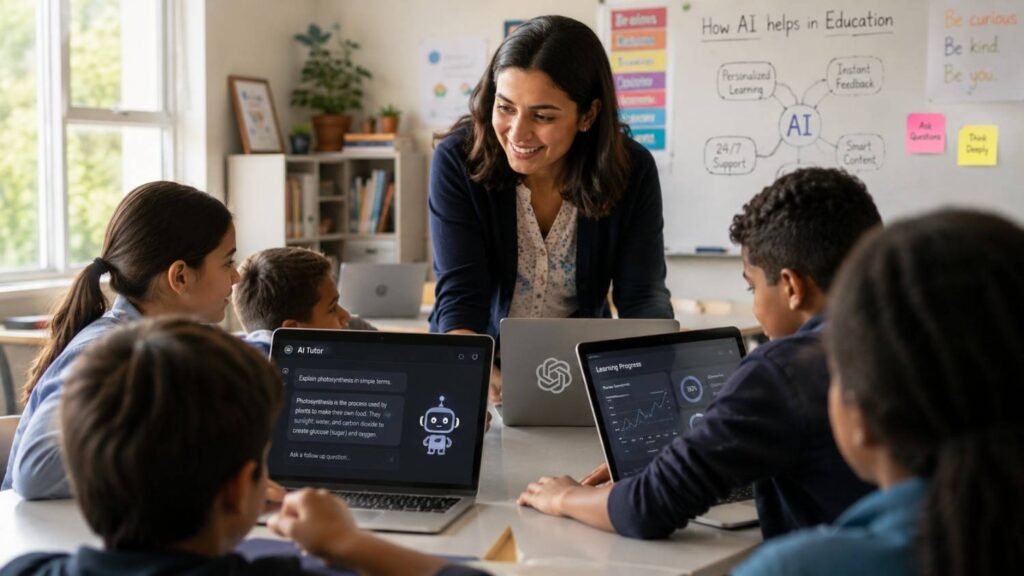
OpenAI can help address parts of this challenge by making advanced language, reasoning, file analysis, and content-generation capabilities more accessible. A student can request a simpler explanation of a difficult concept, ask for another example, or practise answering questions before an examination. A teacher can create several versions of an activity, prepare a lesson outline, draft a rubric, or rewrite a family communication in clearer language. A researcher can review uploaded documents, explore analytical approaches, or improve the structure of technical material.
These examples show how OpenAI can transform the education sector, but transformation should not be confused with replacement. Education depends on motivation, trust, social interaction, professional ethics, subject expertise, safeguarding, and a deep understanding of individual learners. An AI system may support these processes, but it cannot assume full responsibility for them.
One thing I always recommend is beginning with a specific educational problem rather than beginning with the technology. A school may want to reduce teacher preparation time. A university may want to improve access to course support. A student-services team may need a better way to organize approved information. Each objective requires a different solution, level of oversight, and method of evaluation.
The most effective approach is to treat OpenAI as a supportive educational capability. Institutions should use it to improve access, extend learning support, reduce repetitive work, and strengthen research while maintaining teacher leadership, privacy protection, academic standards, and clear human accountability.
How OpenAI Can Transform Teaching and Student Learning
Teaching and student learning are the most visible areas in which OpenAI can create practical change. Traditional classroom instruction often requires one teacher to support many students at the same time. Even when the lesson is carefully designed, learners may need different explanations, examples, levels of challenge, or amounts of practice. Providing that level of differentiation manually can require more time than an educator has available.
ChatGPT for education can help teachers produce flexible first drafts of learning materials. An educator may request an explanation written for a beginner, a more advanced version for confident learners, and a practical example linked to students’ interests. The teacher can then review the materials, correct inaccuracies, and adapt them to curriculum requirements and classroom needs.
Students can also receive support outside scheduled lessons. They may use AI to review notes, practise recall, generate questions, examine errors, or work through a concept step by step. This can be particularly valuable when the student uses AI as a guided learning partner rather than as a source of finished assignment answers.
The technology must still be used carefully. AI-generated explanations may be incomplete, inaccurate, or unsuitable for the learner’s context. OpenAI states that Study Mode is a study aid and does not replace teachers, tutors, course materials, or academic requirements.
The table below summarizes several education use cases and the safeguards needed to use them responsibly.
| Education Area | Possible OpenAI Use | Main Benefit | Required Safeguard |
|---|---|---|---|
| Student learning | Explanations, quizzes, study plans | More personalized support | Fact-checking and teacher guidance |
| Teaching | Lesson plans, examples, rubrics | Reduced preparation time | Professional review |
| Assessment | Formative feedback and practice | Faster learning feedback | Human grading for important work |
| Research | Summaries, coding, data analysis | Faster exploration | Source verification |
| Administration | Drafting and information support | Reduced repetitive work | Privacy and access control |
| Accessibility | Translation and simplified content | Wider participation | Accuracy and cultural review |
Personalized Tutoring and Study Mode
Personalized learning is one of the strongest applications of OpenAI in education because students do not all understand a concept through the same explanation. One learner may benefit from a visual analogy, another may need a worked example, and another may need the topic broken into smaller steps. ChatGPT can adjust its explanation, difficulty, pace, or questioning style based on the student’s request.
Study Mode is designed around guided learning rather than only providing a final response. OpenAI states that it can ask questions, explain ideas step by step, check understanding, create practice questions, and help students review uploaded materials such as notes, worksheets, slides, syllabus documents, textbook excerpts, images, and PDFs. It is currently available across ChatGPT plans globally on supported web and mobile platforms.
The strongest use is not asking the system to finish graded work. It is asking for hints, explanations, quizzes, or error analysis. A student can describe their reasoning, attempt the next step, and ask why their approach failed.
Teachers should model these learning behaviours explicitly. Students need examples of productive prompts, verification techniques, and responsible boundaries. The objective is to increase independence and understanding, not create dependence on instant answers.
Students and educators can also explore the official OpenAI Study Mode resources for guidance on using AI to support learning responsibly.
Lesson Planning, Feedback, and Teacher Productivity
Teachers spend substantial time preparing lessons, differentiating activities, writing instructions, developing examples, creating assessments, documenting progress, and communicating with families. OpenAI can reduce the time required to produce an initial draft, especially when the teacher provides a clear learning objective, age group, subject, time limit, and classroom context.
For example, an educator could request a 40-minute lesson outline, three levels of reading activity, a vocabulary list, an exit ticket, and a simple rubric. The resulting material should not be used without review. The teacher must check factual accuracy, curriculum alignment, difficulty, accessibility, tone, and cultural suitability.
ChatGPT for Teachers provides a managed workspace for verified U.S. K–12 educators and staff. OpenAI says the plan is free through June 2027, includes education-focused protections and administrative controls, and is not currently intended for student accounts.
AI can also support formative feedback. It may identify unclear sentences, generate questions that encourage revision, or explain common mistakes. Final grades and high-impact judgments should remain with educators.
The central productivity benefit is not simply faster document creation. It is the possibility of returning time to teachers so they can focus more on instruction, mentoring, classroom relationships, and individual student needs.
Accessibility and Multilingual Learning
OpenAI can support accessible learning by presenting the same concept in different formats, reading levels, and languages. A student who struggles with technical terminology may request a simpler explanation while preserving the core meaning. A multilingual learner may compare an explanation across languages, practise academic vocabulary, or ask for difficult instructions to be rewritten more clearly.
Teachers can use the same capabilities to prepare bilingual family communications, glossaries, scaffolded reading materials, alternative examples, and clearer task instructions. Students who find it easier to discuss ideas aloud may also use available voice features to explain their thinking, ask questions, or practise verbal responses.
Study Mode can work with uploaded educational materials when those capabilities are available in the user’s chat. OpenAI advises users to upload the relevant file or image and specify the exact page, question, or section they want to study.
These tools can widen participation, but they are not a complete accessibility solution. Translation can lose cultural meaning, simplified language may remove necessary detail, and generated material may not meet a learner’s formal accommodations.
Educators should therefore treat AI as one support within a broader inclusive-design strategy. Specialist staff, accessibility services, approved assistive technology, and individual student plans remain essential where professional assessment or legally required accommodation is involved.
How OpenAI Can Improve Research, Administration, and Access
The influence of OpenAI extends beyond classroom teaching. Schools, colleges, and universities also manage research, admissions, student services, information technology, communications, professional development, policy, library services, career support, and large collections of institutional knowledge. Many of these activities involve repetitive information work that can be improved without transferring final responsibility to AI.
Staff may use approved tools to summarize documents, organize meeting notes, produce first drafts, compare information, translate routine messages, or prepare answers to common questions. These uses can reduce the time spent locating and restructuring information, allowing employees to focus on unusual cases that require experience and judgment.
ChatGPT Edu was created for deployment across students, faculty, researchers, and campus operations. OpenAI describes it as a university-focused offering that supports advanced tools, data analysis, file-based work, administrative capabilities, and institutional use.
Arizona State University provides an example of a broad institutional approach. OpenAI’s ASU customer story describes the university’s work to integrate ChatGPT into higher education while emphasizing innovation, personalized learning, inclusion, and responsible use. Because this is a company-published customer story, it should be treated as an implementation example rather than an independent evaluation of learning outcomes.
Institutions should still assess whether AI is appropriate for each process. High-impact academic, disciplinary, legal, admissions, or wellbeing decisions require direct human responsibility. The best administrative and research uses usually improve access to information, assist qualified professionals, or reduce routine drafting rather than allowing AI to make final decisions about students.
| OpenAI Tool | Primary Users | Best Educational Use | Key Advantage |
|---|---|---|---|
| ChatGPT Study Mode | Students | Guided learning, quizzes, concept explanations | Encourages deeper understanding through step-by-step learning |
| ChatGPT Edu | Universities | Teaching, research, campus operations | Secure institutional AI with admin controls |
| ChatGPT for Teachers | Educators | Lesson planning, classroom resources, communication | Reduces preparation time and improves productivity |
| OpenAI Academy | Teachers & Administrators | AI training and professional development | Builds AI literacy and responsible usage skills |
| Custom GPTs | Schools & Universities | Internal policy assistants and course support | Provides institution-specific AI experiences |
Research and Higher Education
OpenAI can support researchers and university students across several stages of academic work. It may help clarify an early research question, identify possible methods, explain unfamiliar terminology, review code, organize uploaded material, suggest a report structure, or improve the clarity of a presentation. These capabilities can make exploration faster, especially when the researcher is moving into an unfamiliar area.
ChatGPT Edu is designed for university communities, including students, faculty, researchers, and campus operations. Its institutional environment allows universities to make advanced ChatGPT capabilities available under centrally managed controls rather than relying only on personal accounts.
AI assistance does not remove scholarly responsibilities. Researchers must check original sources, verify citations, examine methods, protect confidential or unpublished data, disclose AI use when required, and follow institutional ethics and academic-integrity rules. Generated summaries should never replace reading the underlying publication when the claim is important.
Universities can also create approved assistants for particular programmes or services. A controlled GPT could explain a course handbook, guide users through laboratory procedures, or help students locate information within approved institutional resources.
The strongest transformation will occur when AI capability is combined with research literacy. Students and researchers must learn not only how to generate material, but how to question its validity, document their process, and defend the reasoning behind their final work.
School and Campus Administration
Educational institutions handle a large volume of routine information. Staff answer repeated questions, prepare announcements, summarize procedures, create meeting notes, draft reports, organize policy material, and direct students toward the correct service. OpenAI can help produce first drafts and make approved information easier to navigate.
A university might build a managed assistant for orientation, library services, careers, or internal policies. A school district might create a staff-facing tool that helps educators locate professional-development resources or understand routine administrative processes. Such tools can improve response times, but they should be grounded in current, approved information and include a clear escalation path.
Managed workspaces provide important controls for institutional administration. OpenAI lists enterprise access-management features such as roles, single sign-on, automated provisioning through SCIM for eligible Edu customers, administrative APIs, and audit-log capabilities across its organizational offerings.
Administrators should define which information the assistant may access and which tasks require a person. An AI tool may explain a published application process, but it should not independently decide an unusual financial-aid, disciplinary, or safeguarding case.
Used carefully, OpenAI can reduce repetitive workload and make institutional knowledge more accessible. It should improve the ability of service teams to support students rather than create another barrier between students and the qualified people responsible for helping them.
Broader Access and AI Literacy
Transforming education requires more than providing access to an AI account. Educators and students need the knowledge to use AI critically, safely, and productively. Without that knowledge, the technology may encourage shallow learning, inaccurate work, privacy mistakes, or excessive dependence on generated answers.
OpenAI Academy provides education-focused training for K–12 and higher-education audiences. Its education hub currently includes resources for teachers, curriculum teams, school leaders, IT administrators, university faculty, staff, administrators, and students. It also offers live and recorded learning opportunities on prompting, practical workflows, responsible use, and broader AI fundamentals.
ChatGPT for Teachers provides another route for educator access in the United States. As of July 2026, it is available to verified U.S. K–12 educators and school or district staff, is free through June 2027, and is not currently a student plan.
Access should always include skills. Users need to know how to provide context, request a particular learning process, inspect an output, recognize uncertainty, protect personal information, and decide when professional help is necessary.
Schools should therefore include AI literacy within student digital-literacy programmes and staff development. The goal is not dependence on one product. It is transferable judgment that helps people work responsibly with present and future AI systems.
Related Articles
How Schools Can Adopt OpenAI Responsibly
Responsible adoption begins before a school purchases licences, creates accounts, or announces a major AI initiative. Leaders should first define the educational or operational problem they want to solve. A clear objective might be reducing repetitive lesson-preparation work, improving access to study support, helping multilingual families understand communications, or making approved university policies easier to navigate.
The institution should then identify the groups affected by the change. Teachers, students, parents, school leaders, disability specialists, librarians, IT teams, data-protection staff, academic-integrity officers, and curriculum leaders may see different benefits and risks. Their involvement can reveal practical issues that a technology-only implementation team may overlook.
A responsible strategy should distinguish between low-risk assistance and high-impact decision-making. Creating a draft quiz is not equivalent to grading a final examination. Summarizing a public policy is not equivalent to deciding a disciplinary case. Translating a general message is not equivalent to handling confidential student records. Human review should increase as the consequences become more serious.
Schools also need clear policies. Students must understand when AI is permitted, what assistance must be disclosed, which tasks require independent work, and how they should verify claims. Teachers need guidance about privacy, assessment, copyrighted content, bias, and professional responsibility.
Schools planning long-term AI adoption may also benefit from reviewing practical AI implementation strategies used across enterprise and education environments.
OpenAI’s Study Mode guidance tells users to follow the AI-use policies of their school, instructor, or organization and confirms that the feature does not replace formal academic requirements.
Responsible adoption is therefore a continuous programme involving governance, training, monitoring, communication, and revision. It should not be treated as a one-time software rollout.
| Implementation Step | Purpose | Recommended Action | Expected Outcome |
|---|---|---|---|
| Define Clear Objectives | Solve specific educational problems | Identify use cases before deployment | Focused AI implementation |
| Create AI Policies | Ensure responsible usage | Set rules for teachers and students | Better academic integrity |
| Protect Student Data | Maintain privacy and security | Use managed AI platforms and minimize sensitive data | Safer institutional adoption |
| Train Educators | Improve AI literacy | Provide prompt-writing and verification training | Higher-quality AI usage |
| Pilot Before Scaling | Measure effectiveness | Test one use case and evaluate results | Reduced implementation risk |
| Monitor and Improve | Maintain long-term success | Review feedback, policies, and outcomes regularly | Continuous improvement |
Define Use Cases, Policies, and Boundaries
The first implementation step is to create a limited list of approved use cases. Each use case should name the intended user, educational purpose, permitted information, expected output, responsible reviewer, and actions that remain prohibited.
For example, a teacher may use ChatGPT to draft a lesson activity but must check accuracy, curriculum alignment, accessibility, and age suitability before using it. A student may use Study Mode for practice but may not submit generated work as their own. An administrator may summarize a public procedure but should not place unnecessary confidential student information into an unapproved account.
Create separate guidance for student learning, teaching, assessment, research, administration, and technical development. A general instruction such as “use AI responsibly” is too vague to guide difficult real-life decisions.
Assessment design may also need to change. Educators can request drafts, source notes, process logs, oral explanations, classroom demonstrations, personal reflection, or follow-up questioning that reveals whether the student understands the work.
Clear boundaries do not prevent innovation. They make useful experimentation safer by giving users a shared understanding of what is acceptable. Policies should be reviewed regularly as products, institutional experience, and educational expectations develop.
Protect Data and Maintain Human Oversight
Education providers manage highly sensitive information, including grades, disability accommodations, disciplinary records, family circumstances, safeguarding information, unpublished research, and student communications. Institutions must decide what data may be entered into an AI system, which accounts are approved, who can access outputs, and how long information should be retained.
OpenAI states that organizational data from ChatGPT Edu, ChatGPT for Teachers, Enterprise products, and the API platform is not used to train its models by default. It also describes encryption, identity management, access controls, audit capabilities, and data-residency options for eligible organizational customers.
Users of managed accounts should understand that activity in those accounts is governed by the organization’s agreement, policies, and administrative controls. OpenAI advises users to keep work-related data in the managed account and personal activity in a separate personal account where appropriate.
Privacy features do not remove the need for careful practice. Users should minimize personal information, avoid uploading unnecessary records, verify the correct account, and follow institutional retention and disclosure rules.
Human oversight must remain strongest for grading, admissions, safeguarding, discipline, accessibility decisions, wellbeing, and academic progression. AI may assist with analysis or drafting, but qualified professionals should make, document, and explain consequential decisions.
Pilot, Measure, and Scale Carefully
Institutions should begin with a limited pilot rather than making AI available across every department and workflow immediately. A pilot provides space to examine real behaviour, gather feedback, identify training needs, and measure whether the technology solves the intended problem.
Select a use case with a clear objective and manageable risk. A school might test lesson-resource preparation with a small teacher group. A university might pilot a course-support assistant based on approved programme information. Define the users, duration, data boundaries, review process, and conditions that would pause the pilot.
Useful measures may include teacher preparation time, student participation, accuracy, correction rate, user confidence, service-response time, privacy incidents, and evidence of improved learning or access. A positive impression is not enough; the institution should compare results with the previous process.
Customer stories can provide ideas but should not be treated as independent evidence. OpenAI’s SchoolAI story reports use across one million classrooms in more than 80 countries and company-reported teacher time savings exceeding ten hours per week. These figures describe one customer implementation and should be evaluated in that context.
After the pilot, leaders should review successful and unsuccessful examples with educators, users, technical teams, and governance staff. Scale only the uses that demonstrate clear value, acceptable risk, and strong user understanding.
Quick Answer About How OpenAI Can Transform the Education Sector
OpenAI can transform education by making personalized learning support more widely available, reducing repetitive teacher tasks, strengthening academic research, improving access to institutional information, and helping education providers develop new digital services. Students can use guided tools to explore difficult subjects, practise skills, review uploaded materials, and receive explanations suited to their current level. Teachers can prepare lesson resources, formative assessments, examples, rubrics, and communications more efficiently.
Universities can deploy managed products such as ChatGPT Edu across teaching, research, student services, and campus operations. Schools can also use secure workspaces, professional-development resources, and carefully designed AI assistants. These opportunities do not remove the need for educators. Human judgment remains essential for instruction, assessment, safeguarding, academic integrity, emotional support, and high-impact decisions.
Successful adoption requires clear use cases, staff training, student guidance, approved accounts, privacy controls, output verification, and measurable educational goals. OpenAI should be treated as a supporting capability that increases the capacity of teachers and institutions rather than a substitute for the professionals responsible for student learning and wellbeing.
The Main Areas of Impact
The greatest impact will come from applying OpenAI across the wider education system rather than using it only as a question-answering tool for students. In teaching, it can help educators create differentiated materials, explain concepts in several ways, draft classroom activities, and develop low-stakes practice questions. In learning, students can request hints, review notes, practise recall, test their understanding, and examine why an answer is correct or incorrect.
In higher education, ChatGPT Edu can support students, faculty, researchers, and campus operations through managed institutional workspaces. OpenAI describes its education offering as supporting learning, instruction, research, administration, and campus-wide integration. OpenAI Academy also provides separate resources for K–12 teachers, school leaders, IT teams, curriculum specialists, university staff, faculty, and students.
Administrative teams can use approved tools to summarize policies, draft routine communications, organize information, and prepare responses to common questions. Researchers can use AI to explore ideas, analyze uploaded material, improve code, and structure early drafts. Across all these areas, the most valuable outcome is greater human capacity: educators and staff gain more time for complex work that requires experience, relationships, and professional judgment.
The Conditions for Success
OpenAI will create meaningful educational value only when institutions define why they are using it and establish boundaries around that use. Students should know when AI support is allowed, what must be completed independently, how AI assistance should be disclosed, and how generated claims must be checked. Teachers should remain responsible for learning objectives, curriculum alignment, assessment decisions, and communication with students and families.
Institutions must also select products that match their privacy and administrative requirements. OpenAI states that organizational data from ChatGPT Edu, ChatGPT for Teachers, Enterprise offerings, and the API platform remains controlled by the organization and is not used to train its models by default. Managed products also provide access-management, workspace, and administrative controls.
Training is equally important. Staff need practical experience with prompting, verification, bias, privacy, assignment design, and appropriate escalation. OpenAI Academy currently offers education-focused training for K–12 and higher-education audiences, including teachers, administrators, faculty, students, and IT leaders.
The final condition is ongoing review. Policies, products, and educational practices will continue to change. Institutions should monitor outcomes, collect user feedback, study mistakes, and adjust their approach rather than treating implementation as a one-time technology purchase.
Frequently Asked Questions
Educators, parents, administrators, and students often approach OpenAI with a mixture of interest and concern. They can see the potential for personalized assistance, faster lesson preparation, improved research, and broader access, but they may also worry about inaccurate answers, academic dishonesty, privacy, and the future role of teachers.
These concerns are reasonable because “AI in education” covers many different activities. A student using Study Mode to practise algebra is not the same as a school using an AI system to evaluate formal assessment. A teacher drafting an activity carries less risk than an automated system influencing admissions, discipline, or student wellbeing.
The most useful way to evaluate OpenAI in education is therefore to examine the specific task, the data involved, the possible consequences, and the level of human control. Low-risk drafting and practice may require ordinary professional review. High-impact decisions require stronger governance, documentation, and direct accountability.
Product choice also matters. Personal ChatGPT accounts, managed teacher workspaces, ChatGPT Edu, and API-based applications do not have identical administration or data-handling arrangements. Institutions should review official documentation and their own legal obligations before approving a product for sensitive educational use.
The following answers address common search questions in straightforward language while preserving the practical distinctions that education leaders need when developing policy or planning an implementation.
How Can OpenAI Be Used in Education?
OpenAI can support personalized explanations, practice questions, study plans, lesson preparation, formative feedback, coding, data analysis, research exploration, communication, accessibility, and administrative information work. The appropriate use depends on the learner’s age, institutional policy, data sensitivity, and the consequences of an incorrect result.
Students may use Study Mode to work through a topic, review uploaded notes, receive hints, or create practice activities. Teachers may draft differentiated materials, rubrics, examples, or family messages. University teams may use ChatGPT Edu for teaching, research, staff work, and approved campus services.
OpenAI should not be treated as an automatic authority. Important claims must be checked, and students should not submit generated material as independent work when that violates course rules.
The most effective uses have a clear educational purpose. They help a learner think, help a teacher prepare, or help a qualified professional organize information. They do not remove accountability from the person responsible for the learning process or institutional decision.
Can ChatGPT Improve Student Learning?
ChatGPT can improve access to explanations and practice when students use it to reason, question, revise, and test their understanding. A learner can request a slower explanation, ask for a different example, practise with increasingly difficult questions, or identify why a previous answer was incorrect.
Study Mode is designed for this guided approach. OpenAI says it can ask questions, break large topics into smaller sections, create quizzes or flashcard-style review, work with uploaded course materials, and help students understand why an answer is correct or incorrect.
The learning benefit depends heavily on how the student uses the tool. Asking for a finished answer may reduce productive struggle and hide misunderstandings. Asking for hints, explanations, and feedback can support deeper engagement.
ChatGPT may still make mistakes, overlook information in an uploaded file, or provide a direct answer when guided support would be more suitable. Students should verify important information, use course materials, and follow teacher instructions.
The tool is most valuable when it extends opportunities to practise and reflect rather than replacing the effort required to learn.
Will OpenAI Replace Teachers?
OpenAI is unlikely to replace the complete role of a teacher because teaching involves responsibilities that go far beyond producing explanations or worksheets. Educators build relationships, motivate learners, manage classrooms, interpret behaviour, protect student welfare, assess progress, communicate with families, and adapt instruction using professional knowledge of the learner and local context.
AI can automate or accelerate selected tasks. It may prepare a first draft of a lesson, create practice questions, suggest examples, or help organize formative feedback. These capabilities may give teachers more time for discussion, mentoring, planning, and individual support.
OpenAI itself states that Study Mode does not replace teachers, tutors, course materials, or academic requirements.
The more realistic change is a shift in teacher work. Educators may spend less time producing routine materials and more time reviewing AI-generated resources, designing meaningful assessments, teaching AI literacy, and helping students evaluate information.
Teacher leadership remains essential because generated material can be inaccurate, biased, or unsuitable. The educator must decide whether a tool supports the learning goal and whether its use strengthens or weakens student independence.
What Is ChatGPT Edu?
ChatGPT Edu is an OpenAI offering designed for universities that want to deploy ChatGPT across students, faculty, researchers, and campus operations. It allows institutions to provide managed access rather than depending entirely on individual consumer accounts.
OpenAI describes ChatGPT Edu as supporting advanced ChatGPT capabilities, including work with text and images, file-based tasks, data analysis, custom GPTs, and organizational administration. It was introduced after OpenAI observed university use of its enterprise offerings across institutions such as Arizona State University, Oxford, the Wharton School, the University of Texas at Austin, and Columbia University.
Managed controls are an important part of the offering. OpenAI’s organizational privacy and security documentation describes access management, single sign-on, SCIM provisioning for eligible Edu customers, administrative APIs, and audit capabilities.
ChatGPT Edu does not automatically create an effective university AI strategy. Institutions still need approved use cases, academic-integrity rules, staff training, data governance, accessibility review, evaluation, and support.
The product provides infrastructure and capabilities; the university remains responsible for connecting them to clear educational and operational goals.
Is OpenAI Safe for Student Data?
The safety of student data depends on the specific product, account configuration, institutional controls, user behaviour, applicable law, and the type of information being processed. Schools should not assume that every ChatGPT account has the same governance features.
OpenAI states that data from ChatGPT Edu, ChatGPT for Teachers, its enterprise products, and the API platform is not used to train its models by default. It also provides security and administrative features for organizational customers, including encryption and access-management capabilities.
These controls do not mean users should upload every available record. Institutions should apply data minimization and prohibit unnecessary use of sensitive information. Staff should verify that they are using the approved managed account, understand retention rules, and follow school privacy policies.
Managed-account data may also be subject to the organization’s administrative access, monitoring, retention, and deletion settings.
Schools should complete their own privacy, legal, security, and vendor reviews before deployment. The safest approach combines appropriate technology with clear policy, limited access, user training, and professional oversight.
How Should Schools Handle Academic Integrity?
Schools should replace vague prohibitions with clear, assignment-specific rules. Students need to know which forms of AI assistance are permitted, which uses must be disclosed, and which tasks must demonstrate independent knowledge or skill. A policy should distinguish between brainstorming, language support, tutoring, editing, code generation, source discovery, and submission of generated content.
Assessment design is equally important. Teachers can require planning notes, drafts, source verification, oral explanation, classroom performance, personal reflection, or follow-up questioning. These methods make the student’s reasoning more visible and reduce the value of submitting an answer they do not understand.
Students should also learn that AI-generated material may be inaccurate or unsupported. OpenAI’s Study Mode documentation tells users to follow the policies of their school or instructor and confirms that the tool does not replace academic requirements.
Academic integrity should not be framed only as detecting misconduct. It should include teaching students how to use AI as a transparent learning aid. The goal is to preserve meaningful assessment while preparing learners to use AI responsibly in further education and employment.
Conclusion
How OpenAI can transform the education sector depends less on the novelty of the technology and more on the quality of its implementation. OpenAI tools can expand access to personalized learning support, help teachers prepare flexible resources, strengthen research workflows, improve multilingual communication, and reduce repetitive administrative work. These benefits can create more time and capacity for the human activities that matter most in education.
Products and programmes such as Study Mode, ChatGPT Edu, ChatGPT for Teachers, and OpenAI Academy show that OpenAI’s education work now covers student learning, educator support, professional development, university deployment, and institutional operations.
The opportunity is significant, but so is the responsibility. Generated answers can be wrong. Students may use AI in ways that weaken learning. Sensitive data requires careful protection. Teachers and staff need training, and institutions need clear rules about assessment, disclosure, privacy, access, and human review.
The strongest institutions will not simply give users access to ChatGPT and assume transformation will follow. They will identify specific educational problems, test controlled use cases, review evidence, improve policies, and scale only where the results are positive.
OpenAI should therefore be treated as a supporting layer within education. Teachers remain central, students continue to develop independent thinking, and leaders remain accountable for ensuring that technology improves learning without weakening fairness, trust, privacy, or educational standards.
The Main Transformation Opportunities
The main opportunities include personalized tutoring, differentiated learning materials, faster formative feedback, reduced teacher administration, multilingual support, research assistance, AI literacy, and more accessible institutional information.
These opportunities are connected. When routine preparation becomes faster, teachers may spend more time working directly with students. When guided study support is available outside class, learners may receive help at the moment they become confused. When policies and service information are easier to navigate, administrative teams can focus on complicated situations that require professional attention.
The transformation should still be judged against educational values. Efficiency is valuable only when it supports understanding, inclusion, fairness, privacy, and meaningful relationships.
Real-world projects illustrate the possible direction. Khan Academy has explored GPT-powered tutoring and classroom assistance through Khanmigo, while SchoolAI describes a teacher-in-the-loop model in which educators can observe student interactions and guide the learning environment. These are company-published implementation examples rather than universal evidence that every AI tutoring model improves learning.
OpenAI creates the most value when it extends the capabilities of educators and institutions while keeping responsibility with the people who understand the learner, curriculum, and context.
The Best Next Step for Schools
The best next step is to choose one controlled use case and create a limited pilot. A school might begin with teacher lesson-planning support, while a university might test a course-information assistant, research-support workflow, or internal policy tool.
Define the objective before selecting features. Identify the approved users, permitted information, intended outputs, review requirements, success measures, and conditions that would pause the pilot. Provide training before access begins so participants understand prompting, verification, privacy, and escalation.
Collect examples of both successful and unsuccessful outputs. Review them with educators, students where appropriate, administrators, technical teams, and privacy or governance staff. Measure whether the tool improved the original process and whether users understood its limitations.
The institution should then decide whether to expand, revise, or discontinue the use case. A pilot that does not demonstrate educational value should not be scaled merely because the technology is impressive.
This measured approach helps schools build practical knowledge without exposing the entire institution to an untested process. It also produces evidence that can guide future policies, procurement, training, and responsible adoption.