
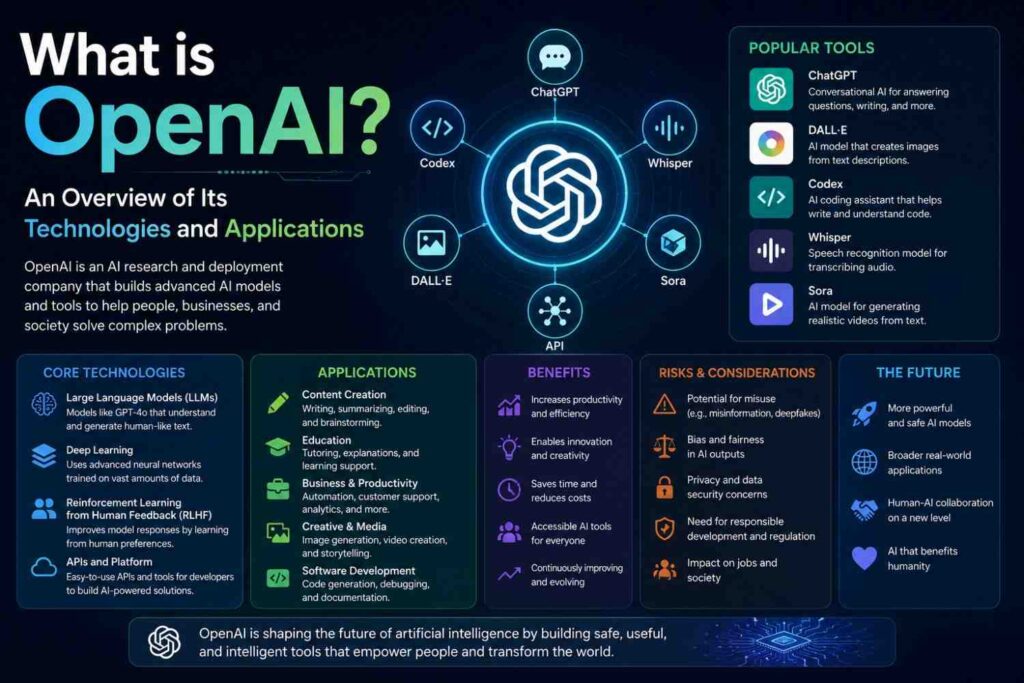
OpenAI is one of the most important names in artificial intelligence today. Many people know it because of ChatGPT, but OpenAI is much more than one chatbot. It builds advanced AI models, developer tools, business solutions, image systems, voice technologies, and research-based AI products.
In simple words, OpenAI creates artificial intelligence systems that can understand text, generate answers, analyze information, write content, help with coding, create images, and support many types of digital work. Its official mission is to make sure artificial general intelligence benefits humanity.
In this article, I will explain What is Open AI? An Overview of Its Technologies and Applications in a simple and professional way. I will cover its history, main tools, technologies, real-life uses, benefits, risks, privacy concerns, and future impact.
What is Open AI and Why Is It Important?
Open AI is an artificial intelligence research and deployment company. This means it does not only study AI in theory; it also creates real products that people, developers, and businesses can use. Open AI became widely known because it made advanced AI easy for normal users through tools like Chat GPT.
The importance of Open AI comes from its role in generative AI. Generative AI can create new text, images, code, audio, and other content from user instructions. This changed how people write, learn, search, work, and build software.
Open AI in Simple Words
Open AI is a company that builds AI systems designed to understand and respond like a smart digital assistant. These systems can answer questions, write drafts, summarize long text, explain complex ideas, and support creative or technical tasks.
For example, a student can ask Chat GPT to explain a science topic. A business owner can ask it to draft product descriptions. A developer can use Open AI models to help debug code. This makes Open AI useful for both simple and advanced tasks.
OpenAI’s Mission
OpenAI’s mission is to ensure that artificial general intelligence benefits all of humanity. Artificial general intelligence, often called AGI, means AI systems that may become capable of solving many types of human-level problems.
This mission matters because powerful AI can bring both benefits and risks. It can improve productivity, education, research, business operations, and creativity. But it also needs safety, privacy, and responsible use.
Quick Facts About OpenAI
| Topic | Details |
|---|---|
| Company Focus | AI research and deployment |
| Most Popular Product | ChatGPT |
| Main Technology Area | Generative AI and multimodal AI |
| Developer Product | OpenAI API |
| Common Uses | Writing, coding, research, automation, learning, support |
| Official Mission | AGI that benefits humanity |
| Main Users | Individuals, developers, businesses, educators, researchers |
How OpenAI Technologies Work
OpenAI technologies work through advanced machine learning models. These models are trained to recognize patterns in language, images, audio, and other data types. When a user gives a prompt, the model predicts and generates the most useful response based on the context.
The main idea is simple: OpenAI models learn from large-scale training, then respond to user instructions. However, they do not “think” like humans. They generate answers based on patterns, reasoning methods, and model training.
Large Language Models and GPT
One of OpenAI’s most important technologies is the GPT model family. GPT stands for Generative Pre-trained Transformer. These models are designed to understand context, generate content, and help with reasoning across text and other inputs.
Large language models can write emails, explain ideas, summarize documents, translate language, generate outlines, and answer questions. They are useful because they understand natural language, so users do not need technical commands.
Multimodal AI
Modern OpenAI systems are not limited to text. Many models can work with different types of input, such as text, images, and sometimes audio. This is called multimodal AI.
For example, a user may upload an image and ask the AI to describe it, analyze it, or explain what is happening. A business may use multimodal AI to process documents, images, product photos, or customer support screenshots.
AI Training and Human Feedback
AI models improve through training, testing, evaluation, and feedback. OpenAI also uses safety methods to make models more helpful and reduce harmful behavior.
Human feedback is important because it helps AI systems learn what users consider useful, safe, and accurate. Still, AI can make mistakes, so human review remains necessary, especially for sensitive topics.
Main OpenAI Products and Tools
OpenAI offers several products and tools for different users. Some products are made for everyday people, while others are built for developers, businesses, and enterprises. The most popular OpenAI product is ChatGPT, but the OpenAI API, image tools, voice tools, and coding tools are also important.
This section explains the main OpenAI products in a practical way so readers can understand how each tool fits into real life.
ChatGPT
ChatGPT is an AI chatbot created by OpenAI. It works like a conversation. Users can ask questions, request writing help, solve problems, brainstorm ideas, summarize text, or learn new topics.
ChatGPT is useful because it feels simple. You type your question, and it replies in natural language. It can help students, writers, marketers, business owners, developers, teachers, and researchers.
Common ChatGPT uses include:
| Use Case | Example |
|---|---|
| Writing | Blog posts, emails, captions, scripts |
| Learning | Simple explanations, quizzes, summaries |
| Business | Customer replies, plans, proposals |
| Coding | Debugging, code explanation, logic help |
| Research | Topic outlines, source checking, summaries |
OpenAI API
The OpenAI API is made for developers and companies. It allows them to add OpenAI models into their own websites, apps, tools, and business systems.
For example, a company can build an AI customer support assistant. A software platform can add AI writing features. A data company can create an AI analysis tool. The API is important because it brings OpenAI technology into custom products.
Image, Voice, Video, and Coding Tools
OpenAI also works on AI tools for images, voice, video, and coding. Image models can generate or edit visuals from prompts. Voice tools can help with speech and audio tasks. Coding tools can support software development, debugging, and technical explanations.
These tools show that OpenAI is not only about chat. It is building a wider AI ecosystem for communication, creativity, automation, and professional work.
OpenAI Applications in Real Life
OpenAI technologies are used in many industries because they can reduce manual work and improve speed. People use OpenAI for writing, learning, business planning, customer service, data analysis, content creation, coding, and research.
The real value of OpenAI comes from practical use. It helps people complete tasks faster, but it works best when users give clear instructions and review the output carefully.
Business and Marketing Applications
Businesses use OpenAI tools for content writing, SEO planning, email marketing, social media captions, product descriptions, customer support, competitor research, and internal documentation.
For example, a marketing agency can use ChatGPT to create blog outlines, meta descriptions, ad copy, and content briefs. A small business can use it to answer customer questions or prepare sales emails.
Business teams can also use OpenAI tools to summarize meetings, analyze reports, and automate repetitive writing tasks.
Education and Learning Applications
OpenAI tools can support education by making difficult topics easier to understand. Students can ask for explanations, examples, practice questions, summaries, and study plans.
Teachers can use AI to create lesson plans, quiz questions, writing prompts, and classroom activities. However, students should not copy AI answers blindly. The best use of AI in education is learning support, not cheating.
Healthcare, Research, and Professional Applications
OpenAI technologies can support healthcare and research workflows, but they must be used carefully. AI can help summarize information, organize notes, explain medical terms in simple language, and support documentation.
In professional fields like healthcare, law, finance, and engineering, AI should assist experts, not replace them. Final decisions should always be made by qualified professionals.
Benefits and Limitations of OpenAI
OpenAI offers many benefits, but users should also understand its limitations. AI can save time, improve creativity, and support learning. But it can also produce wrong, outdated, or incomplete information.
This is why responsible use is important. OpenAI tools are powerful assistants, but they are not perfect sources of truth. A professional user should always check important facts before publishing or making decisions.
Key Benefits of OpenAI
OpenAI tools help users work faster and think more clearly. Writers can create drafts quickly. Developers can solve coding issues. Students can understand topics better. Businesses can improve customer support and internal workflows.
Main benefits include:
| Benefit | Explanation |
|---|---|
| Saves Time | Speeds up writing, research, and planning |
| Improves Productivity | Helps complete routine tasks faster |
| Supports Creativity | Generates ideas, drafts, and outlines |
| Helps Learning | Explains complex topics simply |
| Supports Coding | Helps debug and explain code |
| Improves Business Workflows | Supports automation and customer service |
Main Limitations of OpenAI
OpenAI models can make mistakes. Sometimes they may provide confident answers that are not fully accurate. They may also lack the latest information unless connected to updated sources or browsing tools.
AI can also misunderstand unclear prompts. If the user gives poor instructions, the output may be weak. That is why prompt quality matters.
OpenAI Benefits vs Limitations Table
| Benefits | Limitations |
|---|---|
| Fast content generation | May produce inaccurate facts |
| Useful for learning | Should not replace real study |
| Helps with coding | Code must be tested |
| Supports business tasks | Needs human review |
| Can analyze text and images | May misunderstand context |
| Improves productivity | Privacy settings must be understood |
OpenAI Safety, Privacy, and Responsible Use
Safety and privacy are major parts of OpenAI’s public discussion. AI systems are powerful, so users must understand how their data may be handled and how to use AI responsibly. OpenAI provides privacy controls and separate business data policies, but users should still be careful with sensitive information.
Responsible AI use means checking facts, protecting private data, avoiding harmful use, and keeping humans involved in important decisions.
AI Safety and Model Behavior
OpenAI works on safety methods to make AI more useful and less harmful. This includes model testing, evaluation, feedback, and safety research.
AI safety matters because users may rely on AI answers. If the answer is wrong or unsafe, it can cause confusion or harm. This is especially important in healthcare, finance, law, education, and technical fields.
Data Privacy and User Controls
Users should understand privacy settings before entering sensitive information into any AI tool. OpenAI provides data controls for users and says business/API data is not used for model training by default unless organizations opt in.
Still, the safest rule is simple: do not enter passwords, private client data, confidential documents, financial details, or personal identification information unless you fully understand the platform’s privacy terms.
Responsible AI Use Tips
Use OpenAI tools like a smart assistant, not like a final authority. Always review important answers and verify facts from trusted sources.
Responsible use tips:
- Check facts before publishing.
- Do not share sensitive personal data.
- Review AI-written content for accuracy.
- Test AI-generated code before use.
- Use expert review for medical, legal, and financial topics.
- Give clear prompts for better answers.
- Keep human judgment in important decisions.
What is OpenAI? An Overview of Its Technologies and Applications for the Future
The future of OpenAI will likely focus on more advanced AI assistants, stronger multimodal models, better business automation, safer AI systems, and more useful developer tools. OpenAI is already shaping how people use AI in work, education, software, design, research, and communication.
This is why What is OpenAI? An Overview of Its Technologies and Applications is not only a beginner topic. It is also important for businesses, students, creators, and professionals who want to understand the future of digital work.
Future of AI Assistants
AI assistants may become more useful in everyday life. They may help users plan work, analyze files, create content, write code, search knowledge, prepare reports, and manage tasks.
Instead of only answering questions, future AI systems may support full workflows. For example, an AI assistant may help create a content plan, write the first draft, check grammar, suggest images, and prepare social media captions.
Impact on Jobs and Business Workflows
OpenAI technologies can change how people work. Some repetitive tasks may become faster, such as writing summaries, preparing reports, answering common customer questions, or creating first drafts.
This does not mean every job will disappear. In many cases, AI will become a productivity tool. People who know how to use AI well may become more efficient and competitive.
Why OpenAI Will Remain Important
OpenAI will remain important because it is working on core AI technologies that affect many industries. Its tools are already used for writing, coding, education, customer service, image generation, research, and business automation.
For readers who want to understand modern technology, What is OpenAI? An Overview of Its Technologies and Applications is a strong starting point. It explains how AI is moving from research labs into daily life.
Frequently Asked Questions
This FAQ section answers the most common user questions in a simple, search-friendly, and AEO-focused format. These answers are written for readers who want quick explanations without reading the full article.
What is OpenAI in simple words?
OpenAI is an artificial intelligence company that builds AI tools and models. Its systems can answer questions, write content, generate ideas, help with coding, analyze information, and support business tasks. ChatGPT is the most popular product created by OpenAI.
Is OpenAI the same as ChatGPT?
No, OpenAI and ChatGPT are not the same. OpenAI is the company. ChatGPT is one product made by OpenAI. OpenAI also provides developer APIs, image tools, voice technologies, research models, business tools, and safety resources.
What are OpenAI technologies used for?
OpenAI technologies are used for writing, coding, customer support, learning, research, data analysis, automation, image generation, and business productivity. Developers also use the OpenAI API to add AI features into apps, websites, and software platforms.
Is OpenAI free to use?
Some OpenAI tools may offer free access, while advanced features, business plans, or API usage may require payment. Pricing can change over time, so users should always check the official OpenAI or ChatGPT pricing page before choosing a plan.
Can OpenAI make mistakes?
Yes, OpenAI models can make mistakes. They may give outdated, incomplete, or inaccurate answers. Users should verify important facts before using AI output for publishing, schoolwork, business, medical, legal, financial, or technical decisions.
Is OpenAI safe for business use?
OpenAI offers business products with data privacy and workspace controls. OpenAI states that business and API data are not used for training by default unless the organization opts in. Still, businesses should review privacy, security, and compliance policies before use.
How can beginners use OpenAI?
Beginners can start with ChatGPT. They can ask questions, create summaries, draft emails, learn topics, generate ideas, and practice writing. The best way to get good results is to write clear prompts and review the final answer carefully.
Conclusion
OpenAI is a major company in the artificial intelligence world. It builds AI systems that help people write, learn, code, analyze, create, and automate work. Its most famous product is ChatGPT, but its full ecosystem includes API tools, GPT models, image tools, voice systems, and business solutions.
In this guide, I explained What is OpenAI? An Overview of Its Technologies and Applications in a simple and complete way. We covered how OpenAI works, what products it offers, where it is used, what benefits it provides, and what limitations users should know.
The main point is clear: OpenAI is powerful, but it should be used responsibly. It can save time, improve productivity, and support creativity, but users must still check facts, protect private data, and keep human judgment in important decisions.