
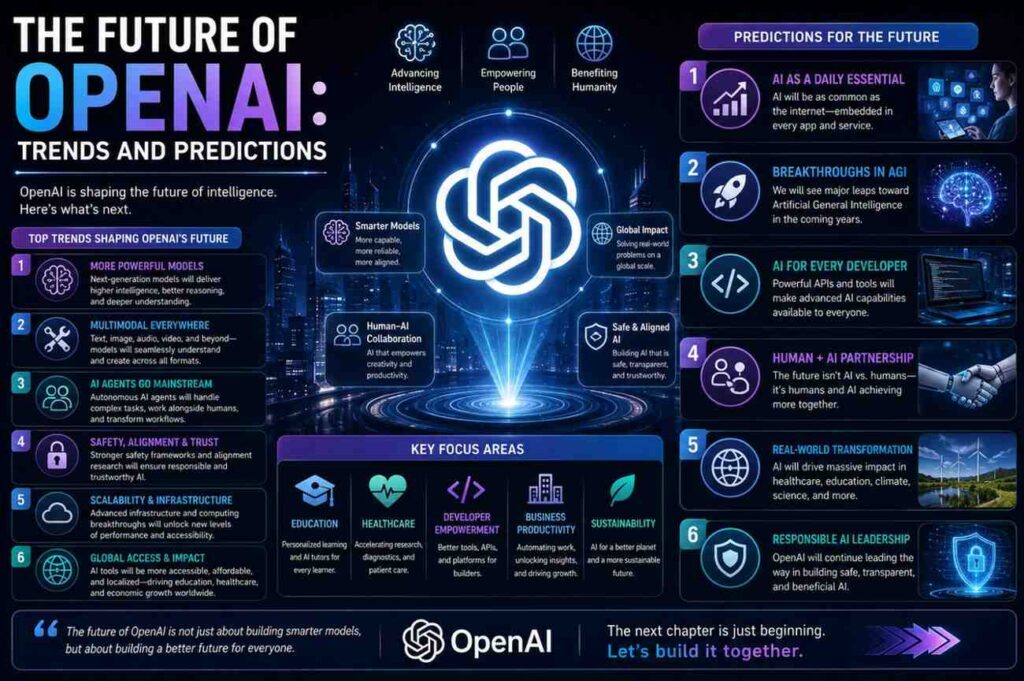
The Future of OpenAI: Trends and Predictions for 2026
The future of OpenAI in 2026 is expected to be shaped by rapid advancements in artificial intelligence capabilities, particularly in reasoning, autonomy, and multimodal understanding. AI systems are becoming more capable of handling complex tasks that involve planning, problem-solving, and real-time decision-making. This evolution is pushing AI beyond simple conversational models toward more intelligent and agent-like systems that can assist in a wide range of professional and personal applications.
One of the key trends for OpenAI is the expansion of agentic AI systems that can independently execute tasks across different digital environments. These systems are expected to integrate deeply with tools, APIs, and software platforms, allowing them to perform actions such as data analysis, workflow automation, and content generation with minimal human intervention. This shift represents a major step toward fully autonomous digital assistants.
Another important development is the growing focus on safety, alignment, and responsible AI deployment. As AI systems become more powerful, ensuring that they behave in accordance with human values and ethical standards becomes increasingly critical. OpenAI and other AI organizations are likely to invest heavily in governance frameworks, testing systems, and oversight mechanisms to reduce risks and improve reliability.
Overall, the future of OpenAI in 2026 points toward more intelligent, integrated, and widely accessible AI systems that transform industries and everyday life. From business automation to education and creative work, these advancements are expected to significantly enhance productivity while also reshaping how humans interact with technology in the long term.
Understanding the Evolution of OpenAI and Its AI Ecosystem
The evolution of OpenAI represents one of the most significant technological transformations in modern computing. Over the past few years, artificial intelligence has shifted from experimental research to practical, large-scale deployment across industries. OpenAI has played a central role in this transition by developing advanced language models, multimodal systems, and API-driven AI solutions that power thousands of applications worldwide.
What makes this evolution particularly important is not just the improvement in model accuracy, but the expansion of AI into everyday workflows. Businesses now rely on AI for content generation, customer support, coding assistance, data analysis, and even decision-making processes. This shift signals that AI is no longer a supplementary tool—it is becoming a core layer of digital infrastructure.
In the context of The Future of OpenAI: Trends and Predictions for 2026, the ecosystem is expected to become more interconnected. AI systems will not operate in isolation but will integrate deeply with cloud platforms, enterprise software, and consumer devices. This creates a unified AI environment where tools communicate seamlessly with one another.
Additionally, OpenAI’s growth is closely tied to advancements in computational efficiency and responsible AI deployment. As models become larger and more capable, optimization and safety mechanisms become equally important. This balance between power and responsibility defines the future trajectory of the AI ecosystem.
What Makes OpenAI a Key Player in Artificial Intelligence?
OpenAI has established itself as a global leader in artificial intelligence due to its combination of research innovation and real-world deployment. Unlike traditional AI labs that focus only on academic breakthroughs, OpenAI bridges the gap between research and usable products. This includes tools like ChatGPT, API-based language models, and multimodal systems that can process text, images, and more.
One of the key strengths of OpenAI lies in its scalability. Its models are designed to support millions of users simultaneously while maintaining performance and reliability. This makes them suitable for enterprise-grade applications, not just experimental use cases. Another defining factor is OpenAI’s focus on alignment and safety, ensuring that AI systems behave in predictable and controlled ways.
From an industry perspective, OpenAI also benefits from strategic partnerships, particularly with cloud infrastructure providers. These collaborations enable faster deployment and continuous model improvement. As a result, OpenAI is not just a research organization—it is a foundational part of the global AI ecosystem shaping digital transformation.
How OpenAI’s Technology Has Evolved Over Time
OpenAI’s technological journey reflects the broader evolution of artificial intelligence. Early models focused primarily on text prediction and basic language understanding. Over time, these systems evolved into highly sophisticated large language models capable of reasoning, summarization, coding, and creative generation.
A major shift occurred when models began supporting longer context windows and better memory handling. This allowed AI systems to maintain coherence across extended conversations and complex tasks. Later, multimodal capabilities were introduced, enabling models to interpret images, diagrams, and structured data alongside text.
Another important milestone is the integration of reinforcement learning from human feedback (RLHF). This technique significantly improved model alignment with user intent, making outputs more useful and safer. Today, OpenAI’s systems are increasingly adaptive, learning from patterns of interaction to improve response quality.
Looking ahead to 2026, this evolution is expected to continue toward more autonomous and context-aware systems that can operate as digital assistants across multiple environments.
The Role of GPT Models in AI Transformation
GPT models have become the backbone of modern generative AI systems. They power applications ranging from chatbots and virtual assistants to content creation tools and coding platforms. Their ability to generate human-like text has fundamentally changed how users interact with technology.
One of the most significant contributions of GPT models is accessibility. They allow non-technical users to perform complex tasks simply by using natural language. This democratization of technology has opened new opportunities for businesses, educators, and creators.
As GPT models evolve, their role is expanding beyond text generation. They are increasingly being integrated into multimodal systems that combine text, image, and audio processing. This enables more interactive and intelligent applications, such as real-time translation, visual analysis, and AI-driven automation tools.
In the broader context of AI predictions 2026, GPT models are expected to become more efficient, accurate, and specialized, supporting industry-specific applications in healthcare, finance, and engineering.
AI Predictions 2026 and the Next Phase of Innovation
The year 2026 is expected to mark a major turning point in artificial intelligence development. AI systems are moving beyond reactive responses toward proactive intelligence, where models can anticipate user needs and execute tasks independently. This evolution is driven by improvements in machine learning architectures, computational power, and data availability.
One of the most important AI predictions 2026 is the rise of autonomous AI agents. These systems will not only respond to prompts but also carry out multi-step workflows, interact with external tools, and make decisions based on real-time data. This shift will fundamentally change productivity across industries.
Another major trend is the convergence of multimodal AI systems. Instead of separate models for text, image, and audio, unified systems will process all inputs together. This will lead to more natural interactions and advanced applications in education, entertainment, and business analytics.
In addition, AI safety and governance will become central topics. As systems grow more powerful, ensuring responsible usage will be critical. Governments and organizations will likely implement stricter frameworks for AI transparency and accountability.
| AI Capability Area | Current State (Pre-2026) | Expected 2026 Advancement | Business / User Impact | Strategic Importance |
|---|---|---|---|---|
| Multimodal Processing | Mostly text + limited image support | Full integration of text, image, audio, video | Seamless AI interaction across formats | High |
| Autonomous AI Agents | Assistive only, user-driven prompts | Self-executing AI workflows | Reduced manual workload in businesses | Very High |
| Context Understanding | Limited long-context memory | Extended memory + persistent context | Better decision-making and continuity | High |
| AI Reasoning Ability | Basic logical reasoning | Advanced multi-step reasoning | More accurate analysis and predictions | Very High |
| Enterprise Integration | Partial API-based integration | Deep system-level integration | Fully AI-powered workflows | High |
| Personal AI Assistants | Task-based assistants | Fully proactive digital assistants | Productivity automation in daily life | High |
Smarter, Multimodal AI Systems
Multimodal AI represents one of the most transformative advancements in artificial intelligence. These systems are designed to understand and generate multiple types of data, including text, images, audio, and video, within a single unified framework.
This capability significantly improves real-world usability. For example, a user could upload a document, an image, and a voice note, and the AI would analyze all inputs together to generate a meaningful response. This level of integration reduces friction and enhances productivity.
In education, multimodal AI can create interactive learning environments where students engage with visual and auditory content simultaneously. In healthcare, it can assist in analyzing medical images alongside patient records for better diagnosis.
By 2026, multimodal systems are expected to become the standard rather than the exception. This will mark a shift from single-purpose AI tools to fully integrated intelligence platforms.
More Autonomous AI Agents
Autonomous AI agents represent the next stage in AI evolution. Unlike traditional models that require constant user input, these agents can perform tasks independently based on high-level instructions.
For example, an AI agent could manage an entire marketing campaign—creating content, scheduling posts, analyzing performance, and optimizing strategy without continuous human intervention. This level of autonomy is made possible by improvements in planning algorithms and tool integration.
These systems will also be capable of interacting with other software applications, APIs, and databases, making them highly versatile. However, autonomy also introduces challenges related to control, transparency, and safety.
Despite these challenges, autonomous AI agents are expected to become a major productivity driver by 2026, especially in enterprise environments.
Enhanced Reasoning and Decision-Making
One of the most anticipated advancements in AI is improved reasoning capability. Future systems will not only generate responses but also evaluate multiple possibilities before providing recommendations.
This will significantly enhance decision-making in business and research environments. For instance, AI systems will be able to analyze financial trends, simulate outcomes, and suggest optimized strategies based on data-driven insights.
Improved reasoning also reduces hallucinations and increases reliability. As models become more structured in their thinking processes, users can trust outputs for more critical applications.
By 2026, reasoning-enhanced AI systems will likely be integrated into analytics platforms, enterprise dashboards, and strategic planning tools.
AI in Business 2026: Transformation Across Industries
AI adoption in business is accelerating rapidly, and by 2026 it will become deeply embedded in almost every industry. Companies are increasingly using AI to streamline operations, reduce costs, and improve customer engagement.
The biggest transformation is happening in automation. Routine tasks that once required human effort are now being handled by intelligent systems. This includes customer service, data entry, reporting, and even strategic analysis.
Another major shift is personalization. AI systems are capable of analyzing user behavior in real time and adjusting services accordingly. This leads to improved customer satisfaction and higher conversion rates.
Overall, AI is no longer a competitive advantage—it is becoming a business necessity.
| Area of Impact | Industry Example | AI Application in 2026 | Benefit | Level of Transformation |
|---|---|---|---|---|
| Healthcare | Hospitals & diagnostics | AI-assisted imaging + patient data analysis | Faster diagnosis, better accuracy | Very High |
| Finance | Banking & fintech | Fraud detection + predictive analytics | Reduced risk, improved forecasting | Very High |
| Education | Schools & e-learning | AI tutors + personalized learning paths | Adaptive learning experience | High |
| Marketing | Digital agencies | AI-generated campaigns + customer targeting | Higher conversion rates | High |
| Software Development | Tech companies | AI coding assistants + debugging tools | Faster development cycles | Very High |
| E-commerce | Online retail platforms | Recommendation engines + personalization | Increased sales & engagement | High |
Automation of Business Operations
AI-driven automation is transforming how businesses operate at every level. From backend processes like inventory management to front-end services like customer support, AI systems are reducing manual workload and increasing efficiency.
Companies are increasingly using AI chatbots to handle customer queries, freeing human agents for more complex tasks. In finance, AI tools automate invoice processing, fraud detection, and reporting.
This shift allows organizations to scale faster while reducing operational costs. However, successful automation requires proper integration and oversight to ensure accuracy and reliability.
Personalized Customer Experiences
Personalization is one of the most powerful applications of AI in business. By analyzing user data, AI systems can predict preferences and deliver tailored content, recommendations, and offers.
This leads to more engaging user experiences and stronger customer loyalty. For example, e-commerce platforms use AI to recommend products based on browsing history and purchase behavior.
In marketing, AI enables hyper-targeted campaigns that significantly improve conversion rates. As personalization becomes more advanced, customers will expect increasingly customized interactions.
AI-Powered Decision Support Systems
Decision support systems powered by AI are becoming essential tools for modern enterprises. These systems analyze large datasets and provide actionable insights to business leaders.
Instead of relying solely on intuition, executives can use AI-generated reports to guide strategic decisions. This reduces risk and improves accuracy.
In 2026, these systems will become more predictive, helping businesses anticipate market trends and respond proactively rather than reactively.
Generative AI Evolution and the Role of GPT Models
Generative AI is evolving rapidly, expanding far beyond simple text generation into a wide range of creative, technical, and industrial applications. In recent years, it has moved into areas such as video generation, 3D modeling, software development, and real-time simulation. This transformation is turning generative AI into a foundational technology that supports innovation across multiple sectors rather than just serving as a content-generation tool.
GPT models remain at the center of this evolution, acting as the core architecture behind many advanced generative systems. Their strength lies in understanding context, reasoning through complex instructions, and producing coherent, human-like outputs across diverse tasks. Because of this versatility, GPT-based systems are widely used in both consumer applications and enterprise-level solutions.
As these models continue to improve, they are becoming more specialized and efficient, with the ability to support industry-specific workflows. Instead of relying on a single general-purpose model, future AI systems are expected to include tailored versions optimized for fields like healthcare, finance, law, education, and engineering. This specialization will significantly enhance accuracy, reliability, and real-world usability.
Expansion of Generative Capabilities
Generative AI is no longer limited to writing or conversational tasks. It is rapidly expanding into highly creative industries such as filmmaking, animation, game design, digital art, and interactive media. These advancements are enabling creators to produce high-quality content at a much faster pace while reducing production costs.
Modern AI systems are now capable of generating realistic images, composing music, designing virtual environments, and even simulating complex physical or digital worlds. This opens up entirely new possibilities for innovation, allowing businesses and creators to experiment with ideas that were previously too expensive or time-consuming to produce.
By 2026, generative AI is expected to become a standard tool in most creative production pipelines. From independent creators to large studios, AI-assisted content creation will likely be integrated into everyday workflows, fundamentally changing how digital content is designed and delivered.
Improved Context Awareness in AI Models
Context awareness is one of the most important factors influencing AI performance and usability. Future generative models are expected to maintain long-term memory across interactions, allowing them to better understand ongoing tasks, user preferences, and complex instructions. This improvement will lead to more consistent and accurate outputs.
This capability is especially important for advanced applications such as legal analysis, software development, academic research, and business strategy. In these fields, maintaining continuity and understanding multi-step processes is essential for producing reliable results. Improved context handling will significantly reduce errors and improve overall efficiency.
As a result, AI systems will become more dependable and practical for professional environments. Users will be able to work with AI over longer periods without losing context, making collaboration smoother and more productive across complex workflows.
Integration with Enterprise Tools
AI is increasingly being integrated into enterprise ecosystems such as CRM platforms, project management tools, analytics dashboards, and communication systems. This integration allows organizations to automate workflows, streamline operations, and access insights without switching between multiple applications.
By embedding generative AI directly into business tools, companies can improve productivity and reduce manual effort across departments. Tasks such as report generation, customer support, scheduling, and data analysis can be handled more efficiently through AI-powered automation.
By 2026, AI-driven enterprise ecosystems are expected to become the standard across industries. Organizations will rely on interconnected systems where AI continuously supports decision-making, enhances collaboration, and optimizes business processes in real time.
AI Safety, Ethics, and Regulation Trends
As AI systems become more powerful and widely integrated into society, safety, ethics, and regulation have become central priorities in AI development. Developers, researchers, and policymakers are increasingly collaborating to ensure that AI technologies are deployed responsibly and do not create unintended harm. This growing focus reflects the need to balance rapid innovation with long-term societal well-being.
In 2026 and beyond, AI systems are expected to influence critical areas such as healthcare, finance, education, and governance. Because of this, ensuring transparency, accountability, and fairness is no longer optional—it is a fundamental requirement. These safety and ethical considerations are shaping how AI models are trained, deployed, and monitored across industries.
Focus on Responsible AI Development
Responsible AI development emphasizes fairness, transparency, accountability, and inclusivity in AI systems. Developers are actively working to reduce bias in training data and model outputs while improving system reliability and interpretability. The goal is to ensure that AI behaves consistently and fairly across different user groups and real-world scenarios.
This approach also includes continuous testing, auditing, and monitoring of AI systems to detect and correct unintended behavior. By prioritizing responsible development practices, organizations aim to build trust in AI technologies and ensure that their deployment leads to equitable and beneficial outcomes for all users.
Global AI Regulations
Governments around the world are introducing regulatory frameworks to manage the growing influence of artificial intelligence. These regulations are designed to protect user privacy, ensure transparency in AI decision-making, and prevent misuse of advanced systems. As AI becomes more powerful, regulatory oversight is becoming increasingly important.
In the coming years, global AI regulations will play a major role in shaping how AI systems are developed and deployed. Companies will need to comply with legal standards that govern data usage, algorithmic accountability, and ethical considerations. This will help create a more structured and secure environment for AI innovation worldwide.
AI Alignment and Control
AI alignment is a critical area of research that focuses on ensuring AI systems behave in accordance with human values and intentions. This includes preventing harmful outputs, reducing unintended consequences, and maintaining meaningful human control over autonomous systems. Alignment is especially important as AI becomes more capable of independent decision-making.
Maintaining control over advanced AI systems remains one of the most important challenges in the field. Researchers are developing techniques such as reinforcement learning from human feedback, safety constraints, and oversight mechanisms to improve alignment. This ensures that AI systems remain safe, reliable, and beneficial as they continue to evolve.
The Role of AI Assistants in Everyday Life
AI assistants are becoming deeply integrated into everyday life, gradually shifting from optional tools to essential digital companions. They help users manage tasks, access information instantly, and improve overall productivity across personal and professional activities. From setting reminders to summarizing information and automating routine work, AI assistants are making daily routines more efficient and organized.
As adoption continues to grow, AI assistants are also becoming more proactive rather than purely reactive. Instead of only responding to commands, they can now anticipate user needs, suggest actions, and provide context-aware recommendations. This evolution is making them more useful in real-world scenarios where time-saving and decision support are increasingly important.
Evolution of Conversational AI Assistants
Conversational AI has evolved significantly, becoming more natural, fluent, and human-like in its interactions. Modern systems are now capable of understanding context, intent, and even emotional cues, allowing for more meaningful and accurate conversations. This improvement has made AI assistants feel less like tools and more like interactive digital partners.
In 2026, conversational AI is expected to handle complex, multi-turn discussions with greater consistency and awareness. This includes maintaining context over longer conversations, adapting to user preferences, and responding in more personalized ways. These advancements are making AI communication more seamless and intuitive across various applications.
AI in Personal Productivity
AI plays a major role in enhancing personal productivity by helping users manage schedules, organize tasks, and streamline workflows. It can automatically generate reminders, summarize meetings, draft emails, and even assist in content creation, reducing the time spent on repetitive activities.
By handling routine tasks, AI allows individuals to focus on higher-value work such as decision-making, creativity, and strategic thinking. This shift is improving efficiency not only for professionals but also for students and everyday users who rely on digital tools to manage their responsibilities.
Integration into Smart Devices
AI is now deeply embedded into smart devices such as smartphones, cars, wearable devices, and home automation systems. This integration is creating a connected ecosystem where devices communicate with each other to provide a seamless user experience. For example, AI can adjust home lighting, manage navigation in vehicles, or optimize device performance based on user behavior.
As this integration expands, smart environments are becoming more adaptive and personalized. AI-powered systems can learn user preferences over time and automatically adjust settings to improve comfort, convenience, and efficiency. This trend is transforming everyday living into a more intelligent and interconnected experience.
Challenges and Opportunities for OpenAI in 2026
OpenAI operates in a rapidly evolving artificial intelligence landscape where both challenges and opportunities are expanding at the same time. As AI systems become more advanced and widely adopted, the demand for scalable, reliable, and safe models continues to grow. This creates significant pressure to innovate while maintaining performance, safety, and accessibility across global user bases.
At the same time, OpenAI is positioned at the center of one of the fastest-growing technological shifts in modern history. The rise of generative AI, agentic systems, and enterprise adoption presents major opportunities for expansion into new industries and applications. However, achieving this growth requires overcoming technical, competitive, and regulatory challenges.
Scalability and Infrastructure Challenges
One of the biggest challenges OpenAI faces is scalability, as the demand for AI systems continues to increase rapidly across consumer and enterprise markets. Supporting millions of users while maintaining fast response times and high-quality outputs requires highly optimized infrastructure and efficient model deployment strategies.
To address this, significant investment in cloud computing, distributed systems, and hardware acceleration is necessary. As models become more complex and capable, balancing performance with cost and energy efficiency also becomes increasingly important. Ensuring stable and scalable access remains a core technical priority.
Competition in the AI Industry
The AI industry is becoming increasingly competitive, with major research labs and technology companies continuously developing advanced models and platforms. Organizations such as Google DeepMind, Anthropic, Meta, and others are accelerating innovation, leading to rapid advancements across the field.
This competitive environment drives faster progress but also increases pressure to differentiate through performance, safety, usability, and ecosystem integration. Continuous innovation is essential for maintaining leadership in a space where breakthroughs are happening at an unprecedented pace.
Opportunities for Global Expansion
Despite challenges, global AI adoption presents enormous opportunities for OpenAI. Businesses, governments, and individuals across different regions are increasingly integrating AI into daily operations, creating a strong demand for accessible and powerful AI solutions.
This expansion opens new possibilities in education, healthcare, finance, and creative industries, where AI can significantly improve efficiency and accessibility. As adoption grows worldwide, OpenAI has the opportunity to play a major role in shaping how AI is used across diverse markets and communities.
Frequently Asked Questions
Frequently asked questions provide a clear and simple way to understand the most important aspects of a topic without reading through the entire content. They summarize key points into short, direct answers that help readers quickly find the information they are looking for. This section is especially useful for addressing common doubts, clarifying concepts, and improving overall understanding.
In structured articles, FAQs also improve readability and user experience by breaking complex topics into easy-to-digest responses. They highlight the most relevant questions people usually ask and provide concise explanations that support the main content. This makes the information more accessible, practical, and engaging for a wider audience.
What is the future of OpenAI in 2026?
OpenAI is expected to continue advancing toward more capable multimodal and agentic AI systems that can understand text, images, audio, and complex instructions together. These systems will likely become more deeply integrated into everyday tools, enterprise software, and digital workflows, making AI a more seamless part of how people work and interact with technology.
In addition, the focus will increasingly shift toward improving reliability, safety, and long-term usability. As AI becomes more powerful, its role will expand from simple assistance to more structured problem-solving and workflow support across industries.
How will AI change businesses in 2026?
AI will significantly transform businesses by automating routine operations, improving decision-making, and enhancing customer personalization. Many organizations will rely on AI systems to analyze data in real time and provide actionable insights that support faster and more accurate decisions.
This shift will also improve efficiency across departments such as marketing, finance, logistics, and customer service. Businesses that effectively adopt AI will gain a competitive advantage through reduced costs, increased productivity, and better customer experiences.
Will GPT models become fully autonomous?
GPT models are expected to become more advanced and capable of handling multi-step tasks with greater independence. They may be able to plan, execute actions, and use tools more effectively than current systems, moving closer to agent-like behavior.
However, they are not expected to become fully autonomous in the sense of operating without human oversight. Human control will remain essential for safety, ethical decision-making, and preventing unintended outcomes.
What industries benefit most from AI?
Industries such as healthcare, finance, education, marketing, and software development are expected to benefit the most from AI advancements. These sectors rely heavily on data analysis, prediction, and automation, making AI particularly valuable.
AI helps improve accuracy in medical diagnosis, optimize financial risk assessment, personalize learning experiences, enhance marketing strategies, and accelerate software development processes.
How important is AI safety?
AI safety is extremely important because it ensures that advanced systems are used responsibly and do not cause harm. As AI becomes more powerful, risks related to bias, misinformation, privacy, and unintended behavior also increase.
Strong safety measures, ethical guidelines, and regulatory frameworks are necessary to maintain trust and ensure that AI systems remain aligned with human values and societal needs.
Conclusion
The Future of OpenAI: Trends and Predictions for 2026 clearly points toward a world where artificial intelligence becomes more autonomous, intelligent, and deeply integrated into everyday life. AI systems are expected to move beyond simple assistance toward more advanced capabilities such as reasoning, planning, and multi-step task execution. This evolution will significantly impact how individuals and organizations interact with technology.
From business transformation to personal productivity, AI will continue reshaping industries, workflows, and decision-making processes. Companies will increasingly rely on AI-driven systems to automate operations, generate insights, and improve efficiency, while individuals will benefit from smarter tools that enhance creativity, learning, and daily task management.
As these technologies continue to evolve, adaptability and continuous learning will become essential for success. Organizations and individuals that stay informed and embrace these advancements early will be better positioned to take advantage of new opportunities and remain competitive in an increasingly AI-driven world.