
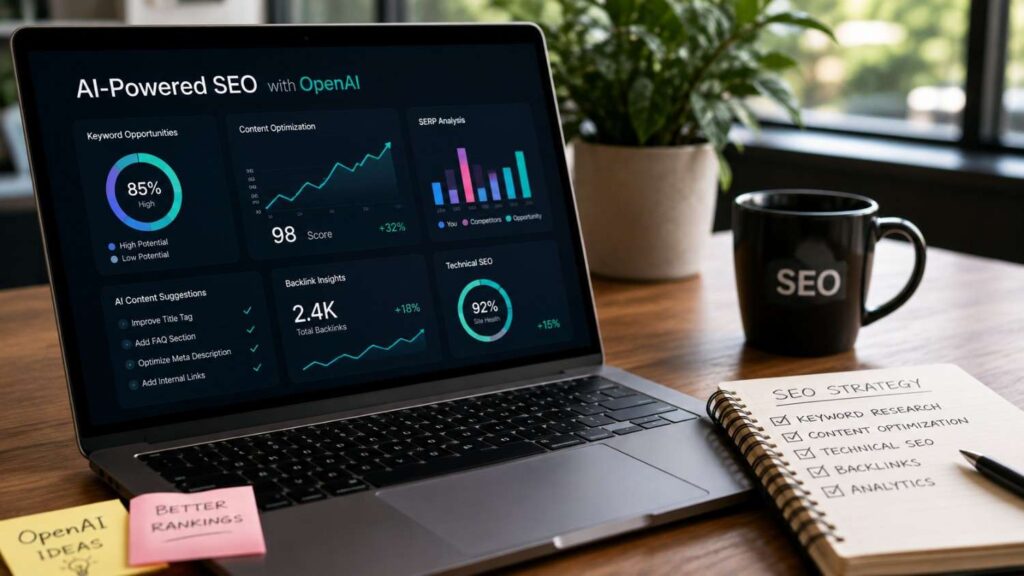
Using OpenAI to Improve SEO Strategies
Using OpenAI to Improve SEO Strategies can make keyword research, content planning, performance analysis, and repetitive optimization work more efficient. However, OpenAI creates value only when it is connected to reliable information and used within a disciplined SEO process. Giving ChatGPT a broad instruction such as “improve my rankings” is unlikely to produce a useful strategy because the model lacks the website data, customer context, commercial priorities, and competitive evidence needed to make a sound decision.
The stronger approach is to provide structured inputs. These may include keyword exports, existing page URLs, crawl reports, Search Console files, customer questions, product documentation, content standards, and conversion goals. OpenAI can then classify the information, identify patterns, summarize opportunities, and present recommendations in a format that an SEO specialist can evaluate.
This distinction matters because OpenAI is not a replacement for Google Search Console, analytics software, professional crawling tools, keyword databases, or subject-matter expertise. It does not independently know the verified search volume of a keyword, the profitability of a service, or the reason a particular page lost traffic. It can help investigate those questions after the relevant evidence has been supplied.
The best use of OpenAI for SEO is therefore workflow improvement rather than one-click content production. It can reduce time spent cleaning keyword lists, building briefs, reviewing metadata, summarizing reports, and preparing implementation tasks. That saved time can be redirected toward original research, expert interviews, stronger user experiences, and deeper strategic analysis.
Google’s people-first guidance asks publishers to provide original information, substantial explanations, clear expertise, and meaningful value beyond what already appears in search results. It also warns against extensive automation used primarily to attract search traffic.
A professional OpenAI SEO process should respect those principles. The objective is not to manufacture the maximum number of pages. It is to produce better evidence, make more informed decisions, and publish content that genuinely helps the intended audience.
What Can OpenAI Realistically Do for SEO?
OpenAI can support both strategic and operational SEO work, but different tools are suited to different responsibilities. ChatGPT works well for interactive research, document review, brainstorming, editing, and analysis of uploaded files. The OpenAI API is more appropriate when an organization needs repeatable processing, structured outputs, software integration, automated classification, or consistent handling of many records.
ChatGPT can search the web for timely information and provide links to relevant sources. It can also analyze supported spreadsheets, CSV files, text files, PDFs, and other uploaded documents. Its data-analysis capabilities can summarize columns, calculate values, identify outliers, create tables, and generate charts. Projects can keep chats, instructions, and reference files together, helping teams maintain context across longer research or content initiatives.
These capabilities are useful, but they do not turn ChatGPT into a complete SEO platform. A crawler is still needed to collect comprehensive technical data. Search Console remains the primary Google tool for measuring search impressions, clicks, queries, and page performance. Keyword platforms may still be necessary for estimated volume, difficulty, paid-search competition, and historical market information.
The practical advantage of OpenAI is synthesis. It can bring together several datasets, explain patterns in plain language, and convert raw findings into an organized action plan. The following comparison shows where it adds value and where specialist tools remain necessary.
| SEO Activity | Useful OpenAI Role | External Evidence Still Required |
|---|---|---|
| Keyword research | Clustering, intent classification, topic mapping | Search volume, competition, conversions |
| Content planning | Briefs, outlines, gap analysis | SERP evidence, audience research |
| Technical SEO | Issue grouping and explanation | Crawl and indexation data |
| Reporting | Trend summaries and action lists | Search Console and analytics exports |
| Content editing | Clarity, consistency, missing-topic review | Expert verification and original experience |
| Automation | Classification and structured outputs | Monitoring, validation, and approval controls |
Research, Classification, and Pattern Detection
OpenAI is especially useful when an SEO task involves interpreting language at scale. A keyword export containing hundreds or thousands of phrases can be grouped by topic, search intent, customer stage, location, product category, or recommended page type. This reduces the manual effort involved in sorting similar queries and helps a strategist see the larger content structure behind individual keywords.
The same method can support content inventory analysis. An SEO team can provide page URLs, titles, organic clicks, impressions, conversions, publication dates, and primary topics. OpenAI can then flag possible overlap, weak title patterns, outdated pages, unusually low click-through rates, or groups of URLs addressing nearly identical questions. ChatGPT’s official data-analysis guidance confirms that uploaded structured files can be summarized, transformed, compared, and visualized, although users should review the generated calculations and assumptions before relying on them.
Context determines the usefulness of the result. A bare keyword list is weak input because it does not explain the website’s audience, products, authority, location, or commercial priorities. Add those details before asking for classification.
The resulting clusters should still be treated as working hypotheses. Review important groups against current search results, business data, and existing pages before making a final content decision.
Where Human Judgment Remains Necessary
OpenAI can produce a clear and confident recommendation even when the available evidence is incomplete. That makes human review essential at every important stage. A model may combine two keywords because their wording is similar, even though searchers expect different page formats. It may suggest merging pages that serve separate audiences or recommend internal links that are topically related but commercially distracting.
Human judgment is also necessary when evaluating factual accuracy. OpenAI should not be treated as the original authority for laws, prices, health information, product specifications, platform policies, or technical requirements. Current claims should be checked against official documentation, and subject-matter experts should review advice in regulated or high-risk industries.
Experience-based content presents another limitation. A model can organize interview notes or explain a documented process, but it cannot create genuine first-hand experience that never occurred. Google’s current generative AI guidance places strong emphasis on unique viewpoints, expert insight, original information, and non-commodity content rather than summaries that merely restate existing material.
The most effective division of responsibility is straightforward. Let OpenAI accelerate organization, comparison, drafting, and quality checks. Let qualified people verify the evidence, add real experience, understand commercial consequences, manage stakeholder priorities, and approve publication.
Removing expert review may make the first draft cheaper. It usually makes the final system less reliable.
Related Articles
How Can OpenAI Improve Keyword and Content Strategy?
A strong ChatGPT SEO strategy begins with customer needs rather than raw keyword counts. OpenAI can help connect search phrases to user problems, levels of awareness, expected page formats, and business outcomes. That is more valuable than simply generating a long list of related keywords, because a successful content strategy must determine which topics deserve pages, which queries belong together, and which opportunities support meaningful conversions.
Begin with verified data. This may include a keyword-platform export, Search Console queries, paid-search terms, site-search data, customer-support questions, sales-call notes, and existing page URLs. Add the website’s audience, service area, products, commercial priorities, and current topical strengths. OpenAI can then group the information and explain the reasoning behind each cluster.
This process is useful for identifying potential keyword cannibalization. Phrases with the same audience, intent, and expected page type often belong on one comprehensive page. Phrases with similar wording but different intent may need separate treatment. For example, a person searching for “SEO software pricing” is likely comparing products, while someone searching “how SEO software works” is still learning.
OpenAI can also help create a topical map. A broad pillar page introduces the main subject, while supporting pages answer narrower questions, compare options, or explain implementation. Internal links connect these pages so readers and search systems can understand their relationship.
The model should not decide priorities by itself. Final decisions need verified demand, business value, current rankings, conversion potential, resource requirements, and competitive evidence. OpenAI provides structure and speed; SEO specialists provide judgment.
The next two steps explain how to turn raw keywords into a practical information architecture and then convert that structure into stronger content briefs.
Businesses looking to strengthen their keyword clustering process can also compare different AI-assisted approaches before finalizing their content strategy.
| SEO Task | How OpenAI Helps | Human Verification Needed |
|---|---|---|
| Keyword clustering | Groups keywords by search intent and topic | ✅ Yes |
| Content briefs | Creates structured SEO content outlines | ✅ Yes |
| Search intent analysis | Identifies informational, commercial, navigational, and transactional intent | ✅ Yes |
| Content gap analysis | Finds missing topics and opportunities | ✅ Yes |
| Internal linking | Suggests relevant internal link opportunities | ✅ Yes |
| Metadata optimization | Generates title tags and meta descriptions | ✅ Yes |
| Technical SEO review | Explains crawl and indexing issues from exported reports | ✅ Yes |
| SEO reporting | Summarizes Search Console and analytics data | ✅ Yes |
Build Keyword Clusters Around Search Intent
Semantic keyword clustering should consider meaning and expected user behavior rather than shared vocabulary alone. Two queries may contain the same main terms but require completely different responses. A commercial comparison query may need a product or service page, while an informational query may need a detailed guide. Combining them carelessly can create a page that satisfies neither audience.
Provide OpenAI with a clear classification framework. Useful columns include the main topic, search intent, customer stage, recommended page type, geographic relevance, existing matching URL, new page requirement, and preferred conversion action. Ask the model to return one row per topic cluster rather than one row per keyword. This makes the strategy easier to review and reduces pressure to create unnecessary pages.
After clustering, manually inspect the highest-value groups. Compare current search results, the types of pages ranking, the dominant questions, and whether Google appears to treat the phrases as one topic. Search behavior and result composition provide evidence that a language model cannot infer reliably from wording alone.
OpenAI should organize verified demand, not manufacture it. It cannot independently provide trustworthy search volume or conversion value. I recommend prioritizing clusters through a combination of audience relevance, commercial importance, realistic ranking potential, existing authority, and the resources required to create the best result.
Create Better Content Briefs and Topic Maps
Once a keyword cluster has been approved, OpenAI can turn it into a detailed content brief. A professional brief should define the target reader, primary search intent, central question, supporting questions, recommended heading structure, relevant entities, evidence requirements, internal-link opportunities, and desired conversion action. It should also identify what the article must do differently from pages that already rank.
This approach is stronger than asking ChatGPT to “write a complete SEO article.” A brief directs the writer without replacing research, expertise, interviews, or editorial judgment. It also creates consistency across teams because writers, editors, designers, and SEO specialists work from the same documented objective.
For topic mapping, provide an existing sitemap or content inventory. Ask OpenAI to classify pages as pillars, supporting guides, commercial pages, tools, comparisons, or outdated assets. It can then identify gaps, duplicated themes, and internal-link opportunities. ChatGPT Projects can support this process by keeping approved instructions, files, chats, and long-running research together in one workspace.
Avoid turning every keyword variation into a separate article. Google’s generative AI optimization guidance explicitly warns against creating many pages for query variations primarily to influence rankings or AI responses. It recommends useful, non-commodity content built for real visitors.
A strong topic map is selective, not inflated.
How Should OpenAI Be Used for SEO Content?
OpenAI can support almost every stage of content development, including research organization, outline creation, gap detection, draft improvement, metadata development, and final quality review. Its role should change according to the maturity of the material. Early in the process, it can help explore questions and organize evidence. During drafting, it can turn approved notes into clear explanations. During editing, it can identify repetition, unsupported claims, weak transitions, and unanswered user questions.
The quality of the result depends heavily on the source material. Generic prompts usually produce generic pages because the model has no unique evidence to work with. Strong inputs may include product documentation, interview transcripts, customer objections, internal performance data, case-study findings, screenshots, original photographs, expert notes, and verified third-party sources.
OpenAI should not be allowed to fill evidence gaps with plausible-sounding statements. When information is unavailable, the draft should use a visible marker such as [SOURCE NEEDED] or [FACT NEEDS VERIFICATION]. This is safer than publishing an unsupported claim simply because it reads confidently.
Google’s guidance focuses on the purpose and usefulness of the content rather than whether a generative AI tool participated in its creation. The company recommends original, reliable, substantial, people-first material and warns that generating many pages without adding value may violate its scaled-content abuse policy.
For AI Overviews and AI Mode, Google continues to recommend ordinary SEO foundations: crawlable pages, clear text, useful internal links, accurate structured data, strong page experience, and valuable original content. No special “AI schema” or machine-readable shortcut is required.
The correct content workflow therefore combines AI efficiency with human evidence, experience, and accountability.
Add Original Value Instead of Producing AI Slop
Low-value AI content usually follows a recognizable pattern. It repeats basic definitions, uses predictable headings, avoids firm conclusions, and makes broad claims without evidence. It may be grammatically correct while offering no practical reason for a reader to trust, save, cite, or revisit the page. Publishing more of this material does not create authority; it creates a larger maintenance problem.
Original value comes from information that cannot be generated from a vague prompt. Examples include first-hand testing, customer interviews, internal data, expert commentary, documented project results, original images, useful templates, calculators, screenshots, or comparisons based on transparent criteria. OpenAI can help organize and explain these assets, but the assets must exist first.
Google’s recent guidance for generative AI features recommends unique viewpoints, compelling first-hand experience, useful non-commodity content, clear organization, and high-quality supporting media. It specifically contrasts original experience with summaries that merely repeat information already available online.
A practical editorial test is to ask whether the page would deserve publication if organic traffic did not exist. Would existing customers find it useful? Would an expert share it? Would a reader learn something that was not obvious before arriving?
When the answer is no, faster AI production does not solve the underlying weakness.
Use a Structured Editing and Verification Process
Do not ask OpenAI to “make this article better” and accept one broad rewrite. That instruction gives the model too much freedom and makes it difficult to understand what changed. A stronger editorial process uses separate review passes, with each pass focused on one clearly defined objective.
Begin with factual verification. Ask the model to list every externally verifiable claim, its supplied source, and any statement that remains unsupported. Next, assess search intent. Confirm that the introduction answers the main question and that secondary sections support rather than distract from it.
A third pass should examine originality. Identify generic passages, repeated ideas, unsupported superlatives, and sections that need examples, data, or first-hand experience. A fourth pass can review structure, paragraph length, transitions, headings, and readability. A final SEO pass can check metadata, internal links, alt text, structured data, and calls to action.
A useful instruction is: “Do not rewrite the article. Create a table showing unsupported claims, repeated points, unanswered user questions, weak transitions, and places requiring expert evidence.”
This keeps the model in an analytical role and protects the writer’s voice. Every important claim must still be checked against a primary source or qualified reviewer. OpenAI accelerates quality control; it does not transfer publishing responsibility away from the website owner.
How Can OpenAI Support On-Page and Technical SEO?
OpenAI can improve on-page and technical SEO work when it receives accurate crawl exports, page inventories, templates, code samples, or structured issue reports. It is useful for classifying problems, explaining technical findings in accessible language, identifying patterns across templates, and producing implementation notes for writers or developers.
Suitable inputs include title tags, meta descriptions, heading structures, canonical URLs, indexability states, status codes, schema types, internal-link counts, crawl depth, word counts, and template identifiers. The model can group recurring issues and help determine whether the problem affects one page, one template, or a large section of the website.
This is different from performing a crawl. OpenAI should not be described as a replacement for dedicated crawling software, server logs, browser testing, Search Console, or URL inspection. It can analyze information collected by those systems, but the quality of its recommendation depends on the completeness and accuracy of the supplied evidence.
For on-page work, OpenAI can generate title alternatives, summarize page intent, identify missing subtopics, evaluate anchor text, and compare content with an approved checklist. For technical work, it can help translate findings into developer-ready tickets containing affected URLs, likely causes, acceptance criteria, and verification steps.
The risk is over-automation. Generating thousands of title tags or internal links without review can produce duplication, awkward wording, and misleading promises. Technical recommendations can also be wrong when the model sees only a spreadsheet and not the live implementation.
A professional workflow uses OpenAI for analysis and preparation, then validates changes through representative samples, official documentation, staging environments, and post-launch monitoring.
Improve Metadata, Internal Links, and Structured Data
To improve metadata, provide the current title, meta description, target query, page purpose, brand rules, audience, and character limits. Ask OpenAI for a small number of genuinely different options rather than hundreds of minor variations. Each title should describe the actual page and avoid promises that the content cannot fulfill.
Internal-link recommendations require similar context. Supply the source URL, target URL, page topics, funnel stages, and existing anchor text. OpenAI can identify semantically related pages, but relevance alone is not enough. A link should help the reader understand a concept, compare an option, or take the next logical step. Automated linking based only on keyword matches often creates repetitive anchors and distracting connections.
For structured data, OpenAI can help draft JSON-LD from verified page information. The markup must accurately represent visible content and follow Google’s applicable technical and quality policies. Google recommends supported formats such as JSON-LD, but correct implementation does not guarantee a rich result.
The OpenAI API can return recommendations in consistent schemas. Its Responses API supports structured JSON output and tools such as web search, file search, and custom functions, while strict schema settings can improve output consistency for automated workflows.
Generated metadata and markup should always be reviewed and tested before publication.
Triage Technical SEO Issues More Efficiently
Large technical SEO reports often contain thousands of rows that are difficult to convert into a practical development plan. OpenAI can group those rows by issue type, template, severity, business impact, or likely root cause. For example, it may separate redirect chains, broken internal links, duplicate titles, canonical conflicts, orphan pages, or unexpected noindex directives.
A reliable process starts with a trusted crawler or platform. Export the relevant issue reports, remove confidential or unnecessary information, label each column clearly, and provide the website’s technical context. Ask OpenAI to identify patterns rather than diagnose every URL independently.
The model might discover that most missing titles belong to one template, that broken links originate from an outdated navigation component, or that canonical conflicts affect a particular filtered category. These patterns can help teams solve the root problem instead of correcting hundreds of individual pages.
However, spreadsheet patterns are not proof. Verify samples manually and inspect the live HTML, rendered page, server response, robots controls, and canonical behavior. Google explains that crawling, indexing, and serving are separate stages, and eligibility does not guarantee that a page will be crawled, indexed, or shown.
OpenAI is most useful for prioritization and communication. It can convert confirmed findings into developer tickets with affected templates, examples, expected behavior, acceptance criteria, and post-release tests. It should not approve its own diagnosis without technical validation.
How Can OpenAI Analyze SEO Data and Automate Workflows?
SEO teams collect large amounts of information from Search Console, analytics platforms, crawlers, keyword tools, content systems, and customer databases. The difficulty is rarely obtaining another report. The difficulty is turning several reports into a clear decision. OpenAI can help by combining structured information, summarizing changes, identifying unusual patterns, and translating findings into prioritized actions.
Google Search Console’s Performance report includes metrics and dimensions such as clicks, impressions, click-through rate, queries, pages, countries, devices, and dates. These reports can help teams understand where visibility is growing, which pages attract clicks, and where strong impressions are not producing enough traffic.
Search Console data also has limitations. Some queries are anonymized for privacy, and the interface may not display every row because of data truncation. Filtering can change totals, and page-level or property-level aggregation can affect interpretation.
OpenAI can help explain these datasets, but the analysis should begin with a specific question. “Which commercial pages gained impressions but lost clicks?” is more useful than “Analyze my SEO.” A clear question determines which calculations, segments, and comparisons matter.
Automation extends this process. The OpenAI API can classify records, generate briefs, check metadata, summarize weekly changes, and convert confirmed audit issues into structured tasks. The workflow must include validation, logging, test data, rate controls, and human approval.
The objective is not to automate every SEO decision. It is to remove repetitive processing while preserving accountability and evidence-based judgment.
Analyze Search Console Exports With Clear Questions
Before uploading a Search Console export, decide what business decision the analysis should support. A vague request encourages a broad summary that repeats visible numbers without producing an actionable conclusion. A focused question guides the model toward the correct filters, calculations, and comparisons.
Useful questions include: Which pages gained impressions but lost clicks? Which non-branded queries rank near the first page and relate to profitable services? Which URLs receive visibility for overlapping keyword groups? Which countries or devices show unusual growth? Which older articles should be refreshed based on declining clicks and continued demand?
ChatGPT can analyze supported spreadsheet and CSV files, calculate summaries, identify anomalies, create tables, and produce charts. OpenAI advises users to prepare structured files with descriptive headers and one record per row, and to review the calculations, code, and assumptions before relying on the outcome.
A useful output should include the opportunity, supporting evidence, recommended action, expected benefit, confidence level, and remaining verification step. Ask the model to explain formulas rather than presenting unsupported conclusions.
Remember that Search Console does not expose every query and that totals can behave differently under filters or aggregation. Treat the findings as prioritized hypotheses. Confirm important opportunities against the original data, current pages, search results, and conversion information before implementing changes.
Build Repeatable Workflows With the OpenAI API
The OpenAI API becomes valuable when the same SEO task must be performed repeatedly across many keywords, pages, or reports. The Responses API supports model outputs alongside tools such as web search, file search, and custom functions. This allows developers to connect language-based analysis with approved data sources and internal applications.
Possible workflows include classifying keywords by intent, generating content briefs from approved clusters, checking metadata against defined rules, matching relevant internal-link targets, summarizing weekly performance changes, or flagging drafts that lack required citations.
File search can retrieve relevant material from uploaded files or vector stores, helping ground outputs in brand guidelines, product documentation, approved research, and internal standards. Vector stores can also be searched with filters and relevance options, which is useful when a workflow must retrieve only the most appropriate internal context.
Structured outputs are important because automation cannot depend on unpredictable prose. Define fields such as URL, issue type, recommendation, priority, evidence, confidence, and approval status. Validate each response before sending it to another system.
Do not connect an unsupervised model directly to a publishing platform or production website. Require review for changes affecting live content, redirects, canonicals, structured data, or customer-facing claims. Effective automation reduces repetitive labor without removing professional control.
Step-by-Step Workflow for Using OpenAI in SEO
A reliable AI-powered SEO workflow begins with a defined business objective and ends with measurement. It should not begin with article generation. Starting with content before understanding the problem often produces pages that are polished but strategically unnecessary.
The first step is to identify the result the organization wants. That may involve increasing qualified leads, improving visibility for a service category, consolidating competing pages, recovering lost traffic, strengthening a topic cluster, or reducing technical errors. A clear objective determines which data should be collected and which metrics matter.
Next, gather evidence from trusted systems. Search Console can provide search performance data. Analytics can show on-site behavior and conversions. Crawlers can identify technical conditions. Keyword tools can estimate demand. Customer interviews and support records can reveal the language and problems of the target audience.
OpenAI should receive only the context necessary for the task. Sensitive information should be removed, and every column or field should be explained. The model can then classify, compare, summarize, and produce a structured recommendation.
Verification follows analysis. Check calculations, sources, representative URLs, current search results, and commercial assumptions. Implement only recommendations that support users and measurable business goals.
Finally, monitor the effect of the change. SEO work should be evaluated through relevant indicators such as clicks, impressions, conversions, indexation, engagement, crawl behavior, editorial quality, and operational time saved.
The workflow below separates each responsibility clearly so OpenAI remains an assistant to the process rather than an unaccountable decision-maker.
Follow This Seven-Step SEO Process
1. Define the objective. State the exact outcome, audience, target pages, timeframe, and success measures. Avoid vague goals such as “improve SEO.”
2. Collect trusted data. Export relevant information from Search Console, analytics, crawl tools, keyword platforms, customer research, and existing content inventories.
3. Prepare the context. Explain the audience, geographic market, products, conversion priorities, brand standards, current URLs, and known limitations.
4. Request structured analysis. Ask for tables, classifications, supporting evidence, confidence levels, unresolved questions, and recommended verification steps.
5. Verify the findings. Review current search results, original data, official documentation, representative URLs, and important factual claims.
6. Implement selectively. Apply only the recommendations that improve user value, technical clarity, content usefulness, or measurable business outcomes.
7. Measure the result. Compare relevant metrics before and after implementation, while accounting for seasonality, site changes, and data limitations.
This sequence keeps each system in the correct role. Specialist platforms provide evidence. OpenAI organizes and interprets that evidence. Qualified professionals make decisions and remain accountable for implementation.
Skipping the verification stage is the most common failure. A fast recommendation is not automatically a correct recommendation, especially when it affects important pages, regulated information, or production systems.
Apply a Human Quality-Control Checklist
Every AI-assisted SEO recommendation should pass a documented human review before publication or implementation. Begin by confirming that the proposed action supports the correct audience and search intent. A technically sound recommendation can still be strategically wrong when it targets irrelevant traffic or distracts users from the page’s primary purpose.
Check whether the recommended page already exists. Creating a new URL without reviewing the content inventory can introduce cannibalization, duplication, and unnecessary maintenance. Confirm that factual claims have reliable sources and that experience-based statements come from real experience rather than generated language.
Review titles, descriptions, headings, internal links, calls to action, and structured data against the visible page. Technical recommendations should be tested on sample URLs or in a staging environment. Sensitive information must not be exposed through prompts, files, logs, or automated outputs.
For recurring API workflows, maintain a test set containing successful examples, difficult edge cases, and known previous failures. Re-run it whenever models, prompts, schemas, tools, or data sources change.
I also recommend recording rejected recommendations. Patterns in those rejections reveal weaknesses in the prompt, missing context, poor source data, or unreliable assumptions. Quality control is not merely a final approval step; it is the feedback system that makes the workflow improve over time.
Quick Answer About Using OpenAI to Improve SEO Strategies
Using OpenAI to Improve SEO Strategies means applying ChatGPT or the OpenAI API to research, classify, analyze, draft, review, and automate selected parts of an SEO workflow. It can help an SEO team organize keyword exports, group queries by search intent, identify content gaps, create detailed briefs, improve metadata, inspect uploaded Search Console reports, suggest internal links, and convert repetitive tasks into structured processes.
The technology is most effective when it works with verified inputs. Search volume, conversions, rankings, crawl data, customer information, and business priorities should come from reliable tools or internal records. OpenAI can interpret those inputs, but it should not be asked to invent missing data or replace specialist platforms.
Human review remains essential. An experienced editor must verify factual claims, assess whether a recommendation fits the audience, confirm that pages do not compete with one another, and decide whether the output supports a real business goal. OpenAI can accelerate the work, but the publisher remains responsible for accuracy and quality.
Google’s current guidance does not treat AI assistance as an automatic problem. It emphasizes useful, original, reliable, people-first content and warns against using automation to produce many low-value pages primarily to manipulate search rankings. Google also states that ordinary SEO fundamentals remain relevant to AI Overviews and AI Mode, with no special schema or separate technical shortcut required.
The correct goal is therefore not faster mass publishing. It is faster analysis, stronger decisions, clearer content, better quality control, and more consistent execution.
| Question | Short Answer |
|---|---|
| Can OpenAI improve SEO performance? | Yes, by improving research, planning, and optimization workflows. |
| Is AI-generated content safe for SEO? | Yes, when it is original, accurate, and reviewed by humans. |
| Can ChatGPT perform keyword research? | It can organize and analyze keywords but needs verified data sources. |
| Does OpenAI replace SEO tools? | No, it complements tools like Search Console and SEO crawlers. |
| Can OpenAI automate technical SEO tasks? | It can analyze exported reports and prioritize issues but cannot crawl websites independently. |
| How should SEO teams use OpenAI? | Combine AI-generated insights with expert review before implementation. |
Frequently Asked Questions About Using OpenAI to Improve SEO Strategies
Using OpenAI for SEO raises practical questions because the technology sits between several established disciplines. It can participate in research, writing, data analysis, coding, and automation, but it does not replace the specialist systems or professional judgment required in those areas.
Website owners often ask whether AI-generated content is acceptable, whether ChatGPT can conduct keyword research, and whether the OpenAI API can automate an agency workflow. The correct answer usually depends on the quality of the input, the type of decision being made, and the controls surrounding the output.
A model can classify keywords, but it cannot independently verify search volume. It can analyze a Search Console export, but it does not remove the report’s aggregation and privacy limitations. It can draft schema markup, but the publisher must confirm that the markup represents visible page content. It can generate an article, but the article still needs original information, evidence, expert review, and a clear purpose.
Google’s current guidance emphasizes helpful, reliable, people-first content and states that ordinary SEO fundamentals continue to apply to AI Overviews and AI Mode. There are no additional technical requirements or special structured-data types that guarantee inclusion in those features.
The following answers address common questions from marketers, writers, agencies, developers, and business owners. Each answer focuses on what OpenAI can realistically support, where its limits remain, and how to use the technology without weakening content quality or professional accountability.
Can OpenAI Improve SEO Rankings?
OpenAI cannot directly guarantee or control search rankings. Rankings depend on many factors, including relevance, content quality, technical accessibility, competition, site reputation, user satisfaction, internal linking, and the strength of the overall search result. No prompt can bypass those conditions.
OpenAI can improve the work that supports SEO performance. It can organize keyword research, identify possible content gaps, create structured briefs, review metadata, analyze uploaded performance reports, explain technical findings, and help teams implement recommendations more consistently.
The effect depends on the quality of the implementation. A stronger brief may lead to a more useful article. Better analysis may identify a page with high impressions and poor click-through rate. Clearer issue grouping may help developers fix a template problem affecting many URLs.
Those improvements can support better organic performance, but they do not create a guaranteed ranking outcome. Search systems change, competitors improve, and not every technically correct page deserves a top position.
Treat any provider promising guaranteed rankings through ChatGPT or automated AI content with skepticism. The responsible promise is improved research and execution, not control over Google’s results.
Does Google Penalize AI-Generated Content?
Google does not state that content is penalized merely because generative AI assisted in creating it. Its guidance focuses on whether the material is helpful, reliable, original, and created primarily for people rather than to manipulate search rankings.
The risk appears when automation is used to produce large numbers of pages without meaningful value. Google’s current documentation says generative AI can be useful for research and for adding structure to original content, but generating many pages without adding value may violate its scaled-content abuse policy.
AI-assisted content should therefore receive the same or stronger editorial review as any other publication. Check factual accuracy, sources, originality, author expertise, page purpose, and whether the article answers the user’s question completely.
The production method does not rescue weak content. A human-written page can be unhelpful, and an AI-assisted page can be useful when experts supply original evidence and carefully review the result.
The practical standard is simple: publish material because it deserves to exist for the audience, not because automation makes it inexpensive to produce.
Can ChatGPT Perform Keyword Research?
ChatGPT can support keyword research by generating seed ideas, grouping supplied keywords, classifying search intent, identifying topical relationships, and converting approved clusters into content maps. It is particularly useful when an SEO professional needs to organize a large export or understand the language patterns across many queries.
However, ChatGPT should not be treated as an independent source of verified search volume, keyword difficulty, advertising competition, or conversion potential. Those values should come from Search Console, paid-search records, analytics, specialist keyword platforms, or internal commercial data.
A strong workflow combines the sources. Export verified keywords and metrics, then provide the website’s audience, location, products, existing pages, and conversion priorities. Ask ChatGPT to group the terms and explain why each keyword belongs in a particular cluster.
Review valuable clusters manually against current search results. Search intent can differ even when phrases appear semantically similar.
ChatGPT performs the language organization well. SEO professionals still need to verify demand, judge business relevance, assess competition, prevent cannibalization, and decide which topics deserve investment.
Can OpenAI Analyze Search Console Data?
Yes. Search Console data can be exported as a spreadsheet or CSV file and analyzed with ChatGPT’s data-analysis capabilities. ChatGPT can summarize trends, group queries, compare date ranges, identify anomalies, calculate additional metrics, and create tables or charts when the file is structured clearly.
The best results come from asking a focused question. For example, request pages that gained impressions while losing clicks, commercial queries ranking near the first page, or URLs receiving visibility for overlapping keyword clusters.
Search Console’s limitations still apply. Some queries are anonymized, not every row is shown, and totals can vary depending on filters and aggregation.
Review the model’s calculations and compare important conclusions with the original export. Add conversion data when business impact matters because high impressions do not automatically indicate a valuable opportunity.
OpenAI can make the analysis faster and easier to understand. It cannot make an incomplete dataset complete or determine commercial priority without additional context.
Can OpenAI Replace an SEO Specialist?
OpenAI cannot replace the full role of an experienced SEO specialist. SEO requires strategic judgment, technical investigation, audience understanding, commercial prioritization, stakeholder communication, implementation management, and accountability for decisions. These responsibilities extend far beyond producing text or grouping keywords.
A model can accelerate parts of the work. It can clean data, summarize reports, create drafts, classify issues, and help prepare recommendations. It may also make specialist knowledge more accessible by explaining technical findings in plain language.
However, it does not independently understand the organization’s politics, financial constraints, development capacity, customer relationships, reputation risks, or long-term priorities. It can also make incorrect assumptions when data is missing.
A skilled specialist knows when not to create a page, when a ranking opportunity is commercially irrelevant, when a technical recommendation is risky, and when a traffic decline requires deeper investigation.
The realistic future is not SEO specialist versus OpenAI. It is an SEO specialist using OpenAI more effectively than a competitor who either ignores the technology or trusts it without verification.
Professional judgment remains the source of direction and accountability.
Is the OpenAI API Useful for SEO Agencies?
The OpenAI API can be valuable for agencies that repeat structured tasks across many clients, websites, keywords, or reports. Suitable uses include keyword-intent classification, content-brief generation, metadata checks, audit organization, internal-link matching, weekly reporting, and quality-control flagging.
The API is most useful when the agency has already documented the process. A vague manual workflow does not become reliable simply because it is automated. Define the inputs, output schema, business rules, verification steps, and conditions that require human review.
OpenAI’s Responses API can work with built-in tools, uploaded information, and custom functions. Structured JSON output can make results easier to validate and send into project-management or reporting systems.
Agencies should log prompts, model versions, outputs, validation failures, approvals, and changes. Client-sensitive information must be handled according to appropriate privacy and security requirements.
Do not connect the system directly to publishing, redirects, canonical changes, or production code without safeguards. The strongest agency workflow automates repetitive processing while keeping strategic decisions and client-facing changes under professional control.
Conclusion
Using OpenAI to Improve SEO Strategies works best when the technology strengthens an existing evidence-based process. ChatGPT can accelerate keyword organization, content briefing, editing, data analysis, and the explanation of technical findings. The OpenAI API can make repeatable workflows more structured and consistent across larger numbers of pages, keywords, or reports.
None of these capabilities removes the need for trusted data sources. Search Console, analytics platforms, crawlers, keyword databases, customer research, and subject-matter expertise remain essential. OpenAI helps connect and interpret that information; it should not invent the missing evidence.
The largest strategic mistake is using AI only to increase publishing volume. Producing more pages is not the same as creating more value. Google’s current guidance continues to emphasize original, useful, reliable, non-commodity content and warns against automation that generates many low-value pages for ranking manipulation. Its guidance for AI Overviews and AI Mode also confirms that established SEO fundamentals remain relevant.
A professional workflow starts with a measurable objective, supplies verified context, requests structured analysis, checks every important recommendation, implements selectively, and monitors the outcome. OpenAI should reduce repetitive labor and improve consistency without removing accountability.
As AI-powered SEO continues to evolve, staying informed about practical implementation strategies can help businesses make better long-term optimization decisions.
The final question is not whether an SEO team used AI. The important question is whether the resulting page, analysis, or technical change is more accurate, useful, original, and effective for the intended audience.
Use OpenAI to improve judgment and execution—not to manufacture content at maximum speed.