
Introduction
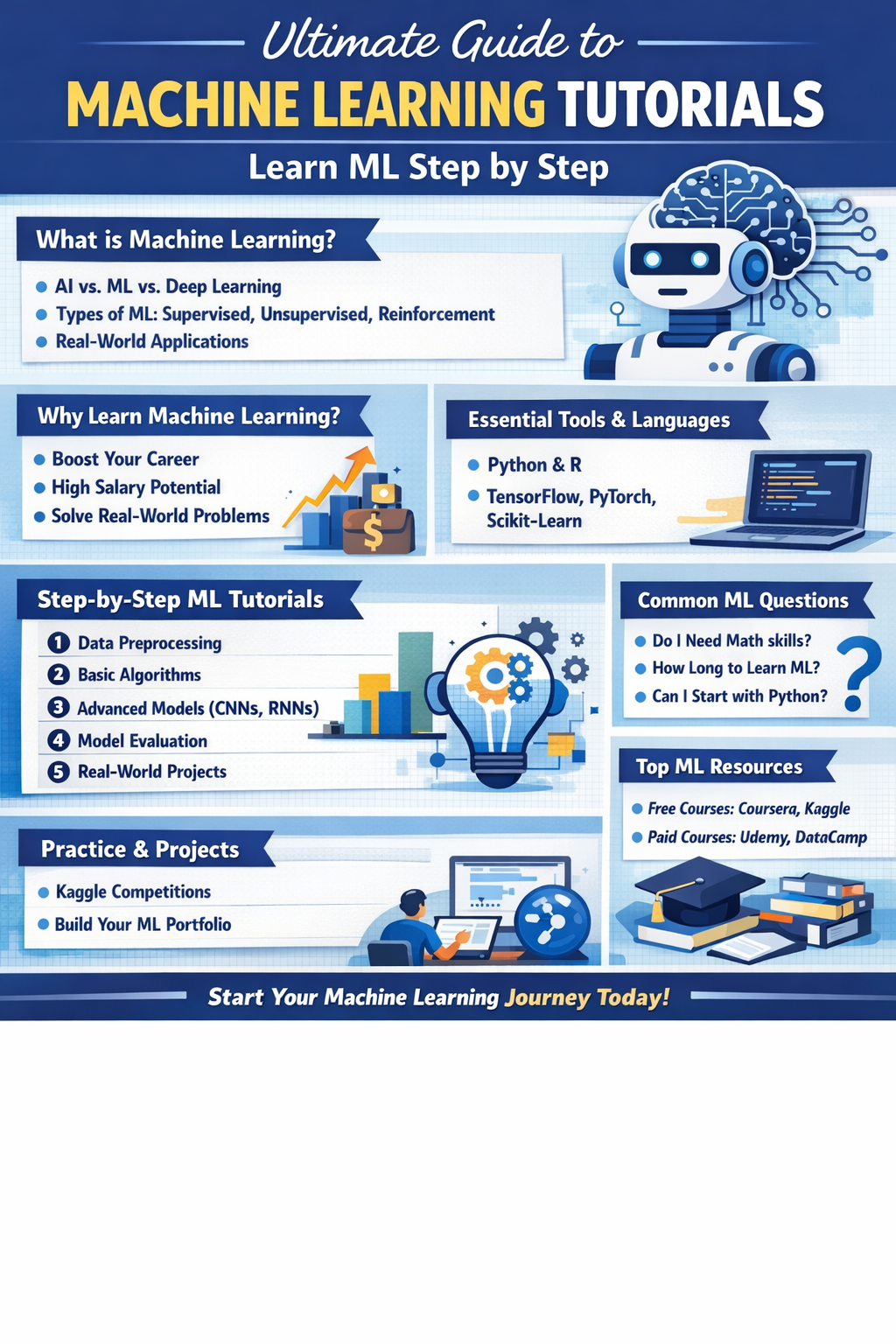
Machine learning (ML) is one of the most transformative technologies of the 21st century, revolutionizing industries ranging from healthcare and finance to marketing and autonomous vehicles. Understanding machine learning can open doors to highly rewarding careers and innovative projects. Whether you are a complete beginner or someone with some programming experience, machine learning tutorials are essential to building the foundational skills needed to excel in this field.
In this guide, we’ll explore step-by-step machine learning tutorials that cover the basics, advanced concepts, tools, algorithms, and practical projects. By the end of this post, you’ll have a clear roadmap for learning ML effectively, including resources, tips, and best practices to accelerate your journey.
What is Machine Learning? A Beginner-Friendly Explanation
Before diving into tutorials and practical exercises, it’s crucial to understand what machine learning actually is. At its core, machine learning is a branch of artificial intelligence (AI) that enables systems to learn from data and improve their performance over time without being explicitly programmed. Unlike traditional programming, where developers write exact instructions, machine learning systems use algorithms to identify patterns, make predictions, and optimize decisions based on historical data.
Definition of Machine Learning
Machine learning is defined as a method of data analysis that automates analytical model building. It uses algorithms that iteratively learn from data to find hidden insights without human intervention. Essentially, machine learning enables computers to perform tasks that typically require human intelligence, such as recognizing speech, detecting images, or recommending products.
Difference Between AI, Machine Learning, and Deep Learning
It’s common for beginners to confuse AI, machine learning, and deep learning. Here’s a simple breakdown:
| Term | Description | Example |
|---|---|---|
| Artificial Intelligence (AI) | Broad field of creating machines that can mimic human intelligence | Chatbots, self-driving cars |
| Machine Learning (ML) | Subset of AI that focuses on learning from data | Predicting stock prices, spam detection |
| Deep Learning (DL) | Subset of ML using neural networks to process complex data | Image recognition, NLP tasks |
This distinction is important because most machine learning tutorials focus on ML algorithms and practical projects rather than AI theory.
Types of Machine Learning
Machine learning is categorized into four main types, each suited for different types of problems:
- Supervised Learning
- Uses labeled data to train models.
- The model learns to map inputs to known outputs.
- Examples: Predicting house prices, email spam detection.
- Unsupervised Learning
- Uses unlabeled data to find hidden patterns or groupings.
- Examples: Customer segmentation, anomaly detection.
- Reinforcement Learning
- The model learns by interacting with an environment and receiving rewards or penalties.
- Examples: Game AI, robotics, autonomous driving.
- Semi-Supervised Learning
- Combines a small amount of labeled data with a large amount of unlabeled data.
- Examples: Text classification, image tagging.
Real-World Applications of Machine Learning
Machine learning is not just a theoretical concept—it powers many applications you interact with daily:
- Healthcare: Predicting diseases, analyzing medical images, drug discovery.
- Finance: Fraud detection, stock market prediction, credit scoring.
- Retail: Recommendation systems, inventory management, personalized marketing.
- Transportation: Self-driving cars, route optimization, predictive maintenance.
- Entertainment: Streaming services recommendations, content classification, video analysis.
Fact: According to Gartner, by 2025, 75% of enterprises will operationalize AI, and ML will be a critical skill for professionals across sectors.
Why You Should Follow Machine Learning Tutorials
Learning machine learning can be overwhelming at first, especially with the vast number of algorithms, tools, and resources available. This is where machine learning tutorials become invaluable. Structured tutorials guide learners step by step, making complex concepts easier to understand and apply. Whether you are a beginner or an intermediate learner, following tutorials helps build practical skills, confidence, and a clear roadmap for learning ML effectively.
Benefits of Learning ML Step by Step
Following structured machine learning tutorials offers several advantages:
- Simplifies Complex Concepts
- Tutorials break down advanced topics like neural networks, reinforcement learning, and feature engineering into manageable steps.
- Visual examples, code snippets, and hands-on exercises make learning interactive.
- Practical Experience
- Unlike reading theoretical books, tutorials often include projects and exercises, giving learners practical experience.
- Examples: building a spam detection model, predicting house prices, or analyzing customer behavior.
- Time Efficiency
- Tutorials provide a structured path, helping learners avoid trial-and-error approaches that can waste months of effort.
- They often include pre-written datasets and starter code to accelerate learning.
- Confidence Building
- Completing tutorials boosts confidence, especially when learners see results from their own models and projects.
How ML Skills Can Improve Your Career
Machine learning is not just an academic subject—it has tangible career benefits.
- High Demand Across Industries: Companies in tech, finance, healthcare, and e-commerce increasingly require professionals with ML expertise.
- Lucrative Salaries: According to Glassdoor, the average salary for a machine learning engineer in the US is over $120,000 per year.
- Versatile Career Paths: Learning ML can lead to roles such as Data Scientist, AI Engineer, ML Researcher, or Business Intelligence Analyst.
- Entrepreneurial Opportunities: With ML skills, you can build AI-driven products, tools, or services for various industries.
How Tutorials Simplify Learning
Machine learning tutorials provide a step-by-step roadmap for mastering the subject:
- Begin with the basics of data and algorithms.
- Progress to intermediate concepts like model evaluation, feature engineering, and advanced algorithms.
- Culminate in real-world projects that reinforce knowledge and create a portfolio.
Tip: Look for tutorials that include both theory and practical exercises. This combination ensures you understand the “why” and “how” behind ML techniques.
Tips for Choosing the Right Machine Learning Tutorial
Not all tutorials are created equal. Here’s how to pick the most effective ones:
- Check Skill Level: Some tutorials target beginners, while others are for advanced learners.
- Interactive Content: Hands-on exercises, quizzes, and projects improve retention.
- Updated Material: ML is evolving rapidly; tutorials should include modern tools and frameworks like TensorFlow, PyTorch, and Scikit-learn.
- Community Support: Tutorials with active forums or Discord/Slack groups provide help when you get stuck.
- Balanced Approach: A mix of theory, coding, and project work ensures comprehensive learning.
Essential Tools and Languages for Machine Learning Tutorials
To follow machine learning tutorials successfully, you need to be familiar with the right tools, programming languages, and frameworks. These tools make it easier to implement ML algorithms, analyze data, and build projects efficiently. Choosing the right stack can significantly enhance your learning experience and productivity.
Programming Languages Used in ML
Machine learning relies heavily on programming, and some languages are more suitable than others:
- Python
- The most popular language for machine learning.
- Simple syntax, extensive libraries, and strong community support.
- Key libraries: NumPy, Pandas, Scikit-learn, Matplotlib, Seaborn.
- R
- Ideal for statistics-heavy machine learning tasks.
- Strong visualization capabilities for analyzing data.
- Popular in academia and research-focused ML projects.
- Java/JavaScript
- Used in enterprise-level ML applications.
- JavaScript allows machine learning models to run in browsers using libraries like TensorFlow.js.
Tip: Beginners should start with Python due to its simplicity and abundance of tutorials.
ML Frameworks and Libraries
Machine learning frameworks provide pre-built functions, reducing the need to code algorithms from scratch. Here are the essentials:
- TensorFlow
- Developed by Google; supports deep learning and neural networks.
- Suitable for large-scale ML projects.
- PyTorch
- Developed by Facebook; widely used in research and academia.
- Flexible and beginner-friendly for neural networks.
- Keras
- High-level API for TensorFlow; simplifies deep learning implementation.
- Scikit-learn
- Ideal for beginners; includes tools for regression, classification, clustering, and preprocessing.
- XGBoost
- Optimized gradient boosting framework for supervised learning tasks.
- High performance for competitions like Kaggle.
Development Environments and Tools
Choosing the right development environment is critical for productivity:
- Jupyter Notebook
- Interactive environment for writing and running Python code.
- Great for experimenting with ML algorithms and visualizing results.
- Google Colab
- Cloud-based Jupyter Notebook environment.
- Free access to GPUs for training models faster.
- Anaconda
- Python/R distribution that simplifies package management.
- Includes Jupyter Notebook and other ML libraries.
- VS Code
- Lightweight code editor with Python support and extensions for ML.
Data Visualization Tools
Visualization is a crucial part of learning ML:
- Matplotlib – Basic plotting and charts.
- Seaborn – Advanced statistical visualizations.
- Plotly – Interactive, web-based charts.
Version Control and Collaboration Tools
Collaborating on ML projects requires tools like:
- Git & GitHub – Track code changes and collaborate with others.
- Google Drive or Dropbox – Store datasets and share notebooks.
Case Study:
Many top Kaggle competitors use Python + Jupyter Notebook + TensorFlow/PyTorch to experiment with datasets and train models. Proper tools save hours of manual work and allow seamless learning when following tutorials.
How to Start Learning Machine Learning: Step-by-Step Tutorials
Learning machine learning can feel overwhelming due to the sheer number of concepts, algorithms, and tools involved. However, by following a step-by-step approach, you can systematically build your skills and confidence. Here’s a comprehensive roadmap based on effective machine learning tutorials.
Step 1 – Understanding the Basics of Data
Before diving into algorithms, it’s crucial to understand data, the backbone of ML:
- Data Preprocessing:
- Cleaning datasets, handling missing values, removing duplicates.
- Ensuring data is in a structured format suitable for algorithms.
- Feature Engineering:
- Selecting and creating important variables that improve model performance.
- Examples: extracting “day of the week” from a timestamp for sales prediction.
- Data Normalization and Scaling:
- Ensures consistent value ranges across features.
- Common techniques: Min-Max Scaling, Standardization.
- Encoding Categorical Data:
- Converting text-based categories into numeric form using One-Hot Encoding or Label Encoding.
Tip: High-quality data preprocessing is often more important than choosing a fancy algorithm. Many beginners fail because they overlook this step.
Step 2 – Learning Basic ML Algorithms
Once you’re comfortable with data, start with simple and widely used algorithms:
- Linear Regression: Predicts numerical outcomes based on input features.
- Logistic Regression: Predicts binary outcomes, such as spam vs. non-spam.
- Decision Trees & Random Forests: Non-linear algorithms suitable for classification and regression.
- K-Nearest Neighbors (KNN): Simple, intuitive classification algorithm based on data similarity.
- Support Vector Machines (SVM): Effective for classification with clear margins between classes.
Example Tutorial: “Predict house prices using linear regression in Python with Scikit-learn” helps beginners understand both theory and practical implementation.
Step 3 – Advanced ML Algorithms
After mastering basics, progress to complex algorithms and deep learning techniques:
- Neural Networks: Mimic brain structures to solve complex problems.
- Convolutional Neural Networks (CNNs): Used for image recognition and computer vision.
- Recurrent Neural Networks (RNNs): Ideal for sequential data like text or time series.
- Reinforcement Learning Algorithms: Train agents through rewards and penalties (e.g., game AI, robotics).
Fact: According to a 2024 report by McKinsey, deep learning projects have increased by 40% in enterprise applications, making advanced ML skills highly valuable.
Step 4 – Evaluating ML Models
Understanding model evaluation metrics is crucial to determine how well your ML models perform:
- Accuracy: Percentage of correct predictions (simple but sometimes misleading).
- Precision and Recall: Useful for imbalanced datasets.
- F1 Score: Balance between precision and recall.
- Confusion Matrix: Visual representation of true positives, false positives, etc.
- Cross-Validation: Technique to ensure your model generalizes well on unseen data.
Tip: Don’t just rely on accuracy—use multiple metrics to get a complete picture of your model’s performance.
Step 5 – Real-World ML Projects
Applying your skills through hands-on projects is the best way to solidify learning:
- Predictive Modeling: Stock price prediction, sales forecasting.
- Image Classification: Recognizing objects in photos using CNNs.
- Natural Language Processing (NLP): Sentiment analysis, chatbots, language translation.
- Recommender Systems: Suggesting products or movies based on user behavior.
Case Study: A beginner ML student built a movie recommendation system using Python and Scikit-learn after completing step-by-step tutorials. This project not only reinforced their learning but also became a portfolio piece that helped land a data science internship.
Additional Tips for Effective Learning
- Start with small datasets and gradually move to larger, real-world datasets.
- Follow interactive tutorials that combine theory and code.
- Document your projects in GitHub to track progress and showcase skills.
- Regularly experiment and tweak algorithms to understand their behavior.
Common Questions in Machine Learning Tutorials
When starting with machine learning tutorials, beginners often have many questions about tools, concepts, and learning strategies. Addressing these questions helps learners stay focused, avoid common mistakes, and accelerate their progress.
What is the Best Way to Learn Machine Learning Quickly?
- Structured Learning: Follow step-by-step tutorials instead of jumping between random topics.
- Hands-On Practice: Implement algorithms while learning theory.
- Small Projects: Build mini-projects like spam detectors or recommendation engines to apply concepts.
- Consistent Practice: Dedicate daily time to coding and experimenting with ML algorithms.
Tip: Consistency beats intensity. Even 1–2 hours daily with proper focus is more effective than sporadic long sessions.
Do I Need a Strong Math Background?
- Mathematics is helpful for understanding the inner workings of ML algorithms.
- Key areas include:
- Linear Algebra: Matrices, vectors (used in neural networks).
- Calculus: Understanding gradients and optimization.
- Probability & Statistics: Essential for modeling and evaluation.
- Practical Note: Many ML tutorials provide step-by-step guidance with code, so beginners can still start building projects even with minimal math knowledge.
Quote: “You don’t have to be a mathematician to do machine learning, but understanding the math helps you become a better practitioner.” – Andrew Ng
How Long Does it Take to Learn Machine Learning?
- The timeline depends on prior experience, consistency, and depth of study:
- Beginner: 3–6 months for basic ML algorithms and small projects.
- Intermediate: 6–12 months to handle advanced algorithms, deep learning, and large datasets.
- Advanced: 1–2 years to master deep learning, reinforcement learning, and real-world deployments.
Tip: Focus on practical projects rather than rushing through theory. Building a portfolio accelerates learning and career opportunities.
Can Beginners Start with Python or R?
- Python is the most recommended language for beginners due to:
- Simple syntax
- Extensive ML libraries
- Community support and tutorials
- R is better suited for statistical analysis and academic research, but less commonly used in large-scale production ML projects.
Advice: Start with Python. Once comfortable, you can explore R or Java for specialized use cases.
How Do ML Tutorials Differ from Online Courses or Bootcamps?
- Tutorials:
- Usually free or inexpensive.
- Short, focused on specific algorithms or projects.
- Self-paced and flexible.
- Online Courses/Bootcamps:
- Comprehensive curriculum covering multiple topics.
- Mentorship, certifications, and career guidance.
- Often more structured with assignments and projects.
Tip: Use tutorials for hands-on learning and courses for a structured, in-depth approach.
Are There Free Resources to Learn ML Effectively?
Yes! Some high-quality free resources include:
- Google’s Machine Learning Crash Course – Interactive tutorials with exercises.
- Kaggle Learn – Step-by-step tutorials with datasets for practice.
- Coursera (Free Audit Option) – Andrew Ng’s Machine Learning course.
- YouTube Channels: Sentdex, StatQuest with Josh Starmer, and FreeCodeCamp tutorials.
Case Study: Many top Kaggle competition winners began with free tutorials, building their portfolios before moving to advanced courses or paid bootcamps.