
As we move into 2026, SEO trends are becoming more sophisticated, driven by technology, changing user behavior, and search engine advancements. To stay ahead, marketers and website owners need to understand these trends and adapt their strategies. Here are the key SEO trends that will dominate 2026:
AI and Machine Learning in SEO
Artificial intelligence (AI) and machine learning are transforming search engine optimization. Google’s algorithms now use AI to better understand search intent, context, and user behavior.
How AI impacts SEO:
- AI-driven tools can analyze large datasets to find keyword opportunities faster than humans.
- Predictive analytics helps forecast which topics will trend, improving content planning.
- AI can optimize meta descriptions, headings, and even content structure for better ranking potential.
Example: Tools like ChatGPT, Jasper, and Surfer SEO allow marketers to generate high-quality, search-optimized content efficiently, saving time while improving performance.
Voice Search Optimization
Voice search continues to grow as smart devices like Alexa, Google Assistant, and Siri become more common. Users often phrase voice searches in natural, conversational language, which changes how content should be optimized.
Voice SEO strategies for 2026:
- Focus on long-tail keywords and question-based phrases.
- Optimize FAQ sections and conversational content.
- Ensure pages load quickly and are mobile-friendly.
Data Insight: According to recent studies, over 55% of households are expected to use voice search regularly by 2026, making it a crucial optimization area.
Mobile-First and Core Web Vitals
Google’s mobile-first indexing means that the mobile version of your website is the primary factor for ranking. Core Web Vitals—metrics that measure loading performance, interactivity, and visual stability—are now essential for SEO.
Key areas to focus on:
- Page speed optimization: compress images, use caching, and minimize code.
- Responsive design for all screen sizes.
- Smooth user experience without intrusive pop-ups or delays.
Fact: Pages with optimized Core Web Vitals are more likely to appear higher in search results and reduce bounce rates, directly impacting traffic and engagement.
E-A-T: Expertise, Authoritativeness, Trustworthiness
Google prioritizes content that demonstrates E-A-T. Websites that show expertise, credibility, and trustworthiness perform better in search rankings.
Ways to boost E-A-T:
- Publish content by experts in the field.
- Include credible references and external links to authority sites.
- Display author bios, credentials, and transparent contact information.
Case Study: Health websites that improved E-A-T factors saw a 30% increase in organic traffic within 6 months, according to Search Engine Journal.
Video SEO Trends
Video content is becoming increasingly important in search results, particularly with YouTube and Google featuring video snippets.
Video SEO best practices:
- Optimize video titles, descriptions, and thumbnails with relevant keywords.
- Add transcripts for better search indexing.
- Use structured data to improve chances of appearing in rich snippets.
Insight: Video searches are growing 20% year-over-year, and including video can increase page engagement and dwell time significantly.
Featured Snippets and Zero-Click Searches
Featured snippets, also called position zero, are search results that show answers directly on Google’s SERP. Capturing these can drive visibility even without clicks.
How to optimize for snippets:
- Answer questions clearly and concisely at the start of content.
- Use bullet points, numbered lists, and tables.
- Structure content with proper H2/H3 headings that match search queries.
Trend: Over 60% of mobile searches result in zero-clicks, making snippet optimization critical to capture attention.
Local SEO Evolution
Local SEO is evolving with hyperlocal searches and voice-activated local queries. Google My Business updates, reviews, and local content now play a bigger role.
Strategies for 2026:
- Optimize Google Business Profile regularly.
- Encourage authentic reviews and respond to customer feedback.
- Create locally-relevant content to target neighborhood or city-specific searches.
Fact: 78% of local mobile searches result in an offline purchase, showing the tangible impact of effective local SEO.
Long-Form Content and Semantic SEO
Long-form, high-quality content remains a strong ranking factor. Semantic SEO helps search engines understand context rather than just keywords.
Implementation tips:
- Create content clusters with pillar pages and supporting articles.
- Use LSI (Latent Semantic Indexing) keywords naturally.
- Focus on solving user intent comprehensively rather than keyword density.
Data Insight: Long-form articles of 2,000+ words earn 77% more backlinks than shorter posts, boosting authority and SEO performance.
Link Building in 2026
Link building remains vital, but quality outweighs quantity. Google values authoritative, relevant backlinks over spammy or low-quality links.
Modern link-building strategies:
- Collaborate with industry influencers and publications.
- Guest posting on reputable websites.
- PR campaigns and creating shareable content like infographics or research studies.
Emerging SEO Technologies
As we progress into 2026, emerging SEO technologies are reshaping how websites are discovered and ranked. Staying ahead of these developments allows businesses to reach users in innovative ways and maintain a competitive edge.
AI Chatbots and Personalized Search
AI-driven chatbots and search personalization are becoming increasingly common. Search engines now consider user behavior, preferences, and past interactions to deliver personalized results.
Implementation strategies:
- Use AI tools to analyze user engagement and tailor content recommendations.
- Implement chatbots on websites to answer queries and guide visitors.
- Create dynamic content that adapts to user interests for higher engagement.
Data Insight: Personalized search can increase user engagement by up to 40%, improving dwell time and signaling relevance to search engines.
Visual and Image Search
With platforms like Google Lens and Pinterest Lens, visual search is gaining momentum. Users can now search using images instead of text, creating opportunities for businesses to optimize images for SEO.
Visual SEO best practices:
- Add descriptive alt text for all images.
- Use high-quality, relevant images to support content.
- Optimize file names and captions with target keywords.
- Implement structured data for images to improve indexing.
Trend: Visual searches are expected to account for 30% of all searches by 2026, highlighting the importance of optimizing multimedia content.
Augmented Reality (AR) and SEO
AR is beginning to influence search behavior, especially in retail, real estate, and e-commerce. Users can interact with products virtually before making a purchase, and search engines are starting to reward websites that integrate AR experiences.
AR optimization tips:
- Implement AR product previews on e-commerce sites.
- Create AR-supported tutorials or demos for services.
- Optimize AR content with metadata and structured data for search visibility.
Example: A furniture retailer that added AR previews for products saw a 25% increase in mobile traffic and higher user engagement compared to standard image catalogs.
Predictive SEO and Future Search Behavior
Predictive SEO uses AI and analytics to forecast search trends and user needs. By analyzing historical data, seasonal trends, and emerging topics, businesses can create content ahead of time that aligns with future search demand.
Predictive SEO strategies:
- Monitor industry trends and competitor content performance.
- Use AI tools to predict which keywords and topics will gain traction.
- Adjust content calendars proactively to stay ahead of audience demand.
Insight: Brands that adopt predictive SEO strategies report up to 20% higher organic traffic growth compared to reactive SEO approaches.
How to Implement SEO Trends in Your Strategy
Understanding the latest SEO trends is only half the battle. The real impact comes from applying these trends effectively to your website and content strategy. Here’s a step-by-step guide to implementing SEO trends in 2026.
Step 1: Conduct a Comprehensive SEO Audit
Before adopting new strategies, evaluate your website’s current performance:
- Check technical SEO: site speed, mobile responsiveness, Core Web Vitals.
- Analyze content performance: traffic, engagement, keyword rankings.
- Review backlink profile: authority, relevance, and quality of incoming links.
Tools to use: Google Search Console, Ahrefs, SEMrush, Screaming Frog.
Step 2: Prioritize Trends Based on Impact
Not every trend may be relevant to your website. Focus on strategies that align with your goals:
- AI-driven content optimization for high-volume blogs.
- Voice search optimization if your audience relies on smart devices.
- Local SEO for businesses serving specific regions.
Tip: Use competitor analysis to see which trends are driving results in your industry.
Step 3: Update Your Content Strategy
Implementing trends often requires refreshing existing content or creating new content:
- Optimize for long-tail keywords and semantic search.
- Add video content, FAQs, and rich media where relevant.
- Structure articles with clear H2 and H3 headings for readability and snippet optimization.
Case Study: Websites that updated older content to include structured data and voice search-friendly FAQs saw a 15–20% increase in organic traffic within 3 months.
Step 4: Optimize Technical SEO
Ensure your website’s technical foundation supports modern SEO trends:
- Improve site speed and mobile responsiveness.
- Implement schema markup for rich snippets, events, and products.
- Maintain a clean URL structure and logical internal linking.
Fact: 53% of users leave a page that takes longer than 3 seconds to load, impacting both traffic and rankings.
Step 5: Build Authority and E-A-T
Focus on trust and expertise to improve rankings:
- Include author bios and credentials.
- Link to authoritative external sources.
- Regularly publish high-quality, research-backed content.
Example: Health and finance websites with strong E-A-T signals consistently outrank competitors for competitive keywords.
Step 6: Monitor, Measure, and Adjust
SEO is an ongoing process. Track the results of your efforts and adapt as needed:
- Measure organic traffic, rankings, and user engagement.
- Monitor Core Web Vitals, backlinks, and CTR.
- Adjust content and strategy based on analytics insights.
Tools to track progress: Google Analytics, Ahrefs, SEMrush, Hotjar.
Common SEO Mistakes to Avoid in 2026
Even with the best intentions, many websites fail to achieve their SEO goals because of outdated practices or common mistakes. Avoiding these pitfalls is essential to fully leverage SEO trends in 2026.
1. Ignoring Algorithm Updates
Search engines like Google update their algorithms hundreds of times per year. Ignoring these changes can cause sudden drops in rankings.
How to avoid it:
- Stay informed about major updates through official Google channels and SEO blogs.
- Regularly audit your site to ensure compliance with new guidelines.
2. Over-Optimization and Keyword Stuffing
While keywords are important, overusing them can hurt rankings and make content unreadable. Search engines now prioritize user intent and natural language over keyword density.
Best practices:
- Include primary and related keywords naturally within content.
- Focus on long-tail keywords and semantic variations.
- Write for humans first, search engines second.
3. Neglecting Mobile Optimization
With mobile-first indexing, websites that are not mobile-friendly risk losing rankings. Slow load times, poor responsiveness, and intrusive pop-ups frustrate users.
Tips:
- Use responsive design across all devices.
- Optimize images and scripts to improve page speed.
- Test your site regularly on mobile devices.
4. Poor User Experience (UX)
Search engines increasingly consider user engagement metrics like bounce rate, dwell time, and click-through rate (CTR). Sites that are confusing or hard to navigate perform worse.
How to fix UX issues:
- Simplify navigation and site structure.
- Ensure fast page loading and minimal distractions.
- Use headings, bullet points, and visuals for scannability.
5. Ignoring Structured Data
Structured data (schema markup) helps search engines understand your content and improves your chances of appearing in featured snippets and rich results.
Recommendation:
- Use schema for products, articles, FAQs, events, and videos.
- Regularly validate your markup using Google’s Rich Results Test.
6. Relying on Low-Quality Backlinks
Low-quality or spammy backlinks can trigger penalties and harm your site’s authority.
Solution:
- Focus on high-quality, relevant backlinks from authoritative sources.
- Disavow spammy links that could damage your SEO.
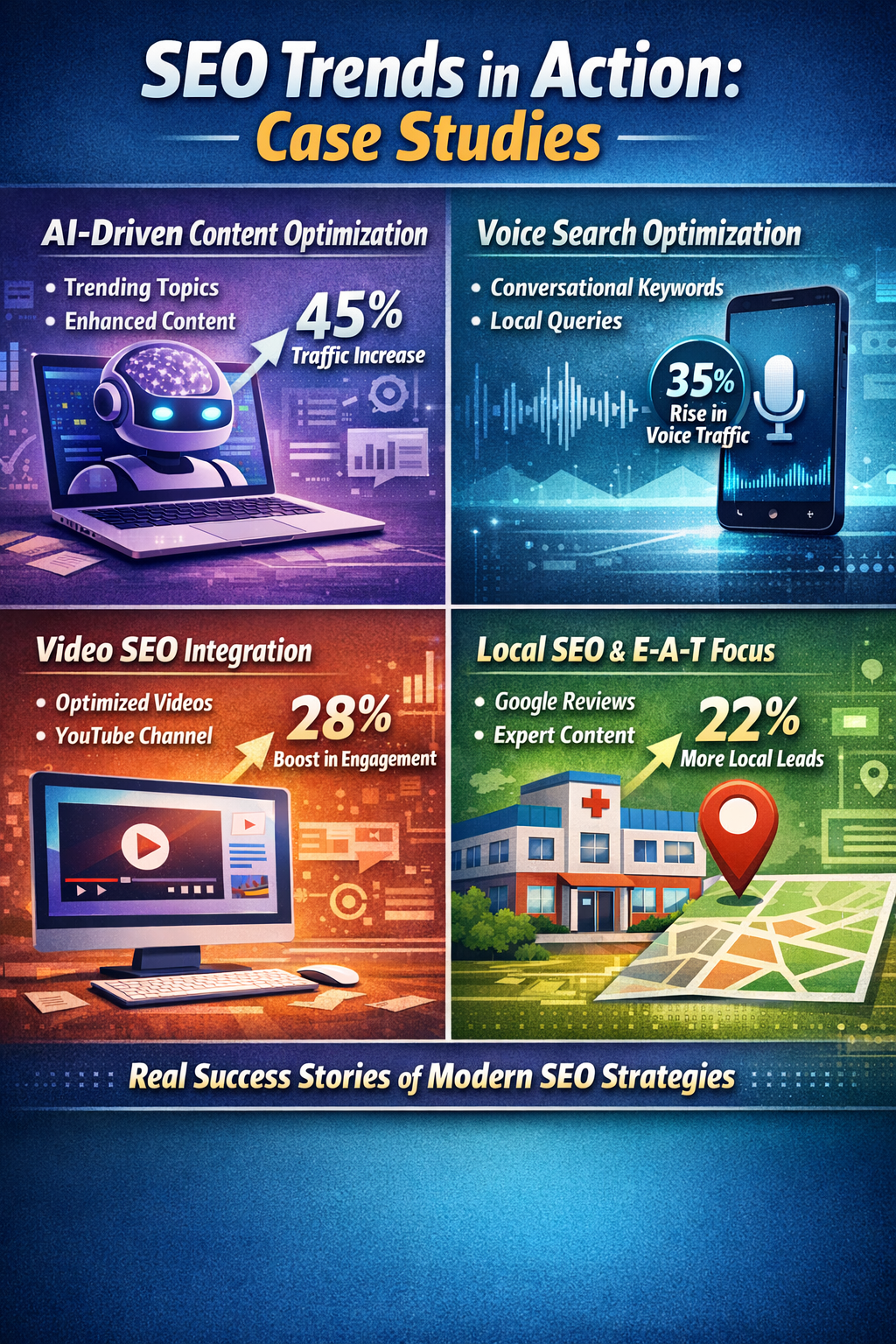
Case Studies: SEO Trends in Action
Understanding SEO trends is one thing—but seeing them applied successfully in real-world scenarios makes their value clear. Here are some examples of businesses and websites that leveraged modern SEO strategies to achieve significant results.
Case Study 1: AI-Driven Content Optimization
Company: TechBlogPro
Strategy: Leveraged AI tools to identify trending topics, optimize headings and meta descriptions, and create semantically rich long-form articles.
Results:
- Organic traffic increased by 45% in 6 months.
- Featured snippets were captured for over 30 targeted queries.
- Content production efficiency improved by 50%, allowing the team to focus on strategy rather than manual research.
Key Takeaway: AI-powered SEO can streamline content creation and help target high-value opportunities more effectively.
Case Study 2: Voice Search Optimization
Company: LocalEats (restaurant directory app)
Strategy: Optimized FAQ pages and local listings with conversational keywords and structured data to capture voice search queries.
Results:
- Voice search traffic grew by 35% in 3 months.
- Higher engagement from mobile users searching for nearby restaurants.
- Local listings consistently appeared in position zero for common queries like “best pizza near me.”
Key Takeaway: Optimizing for voice search is essential for mobile users and hyperlocal SEO, especially as smart assistants become more prevalent.
Case Study 3: Video SEO Integration
Company: FitLife Academy
Strategy: Created a YouTube channel, optimized video titles and descriptions for keywords, added transcripts, and embedded videos on blog posts.
Results:
- Organic traffic to blog posts increased by 28%.
- Video engagement time per page rose by 50%, improving dwell time signals to Google.
- Some videos appeared as rich snippets on SERPs, driving additional click-throughs.
Key Takeaway: Video SEO can enhance engagement and provide multiple channels for content visibility, boosting both traffic and authority.
Case Study 4: Local SEO and E-A-T Focus
Company: HealthWell Clinic
Strategy: Optimized local Google Business Profile, encouraged verified patient reviews, added author bios for all articles, and linked to authoritative health sources.
Results:
- Local search rankings improved, with top 3 placements for 12 high-value local keywords.
- Organic appointments increased by 22% within 4 months.
- Enhanced E-A-T credibility resulted in better SERP trust signals and higher click-through rates.
Key Takeaway: Combining local SEO with strong E-A-T practices delivers tangible business results and strengthens search visibility.