
Introduction
OpenAI has become a household name in the world of artificial intelligence, powering tools like ChatGPT, GPT-4, and other advanced AI models. Its capabilities in natural language processing, content generation, and AI-driven applications have transformed how businesses, developers, and individuals interact with AI. However, OpenAI is not the only player in the market, and there are multiple OpenAI alternatives that provide unique features, competitive pricing, open-source flexibility, and specialized tools tailored for different use cases.http://openbygpt.com
Whether you’re a developer seeking NLP APIs, a business looking to automate content creation, or a startup exploring AI-driven solutions, understanding the best OpenAI alternatives is crucial. These alternatives can offer benefits such as:
- Cost efficiency compared to OpenAI’s subscription plans
- Customizability through open-source or self-hosted platforms
- Specialized features for niche industries
- Better privacy control for sensitive data
In this comprehensive guide, we’ll explore the top OpenAI alternatives for 2026, including their features, use cases, pricing, pros and cons, and tips for choosing the right AI platform. By the end, you’ll have a clear understanding of which alternatives to OpenAI best suit your needs, whether you’re developing AI applications, generating content, or exploring AI research tools.
What Are OpenAI Alternatives?
OpenAI alternatives are AI platforms, tools, or services that provide functionalities similar to OpenAI, such as natural language processing (NLP), text generation, code generation, chatbots, and AI-powered analytics. While OpenAI has become a dominant player in AI research and application, many users look for alternatives due to reasons like pricing, specific features, open-source access, or regional availability.
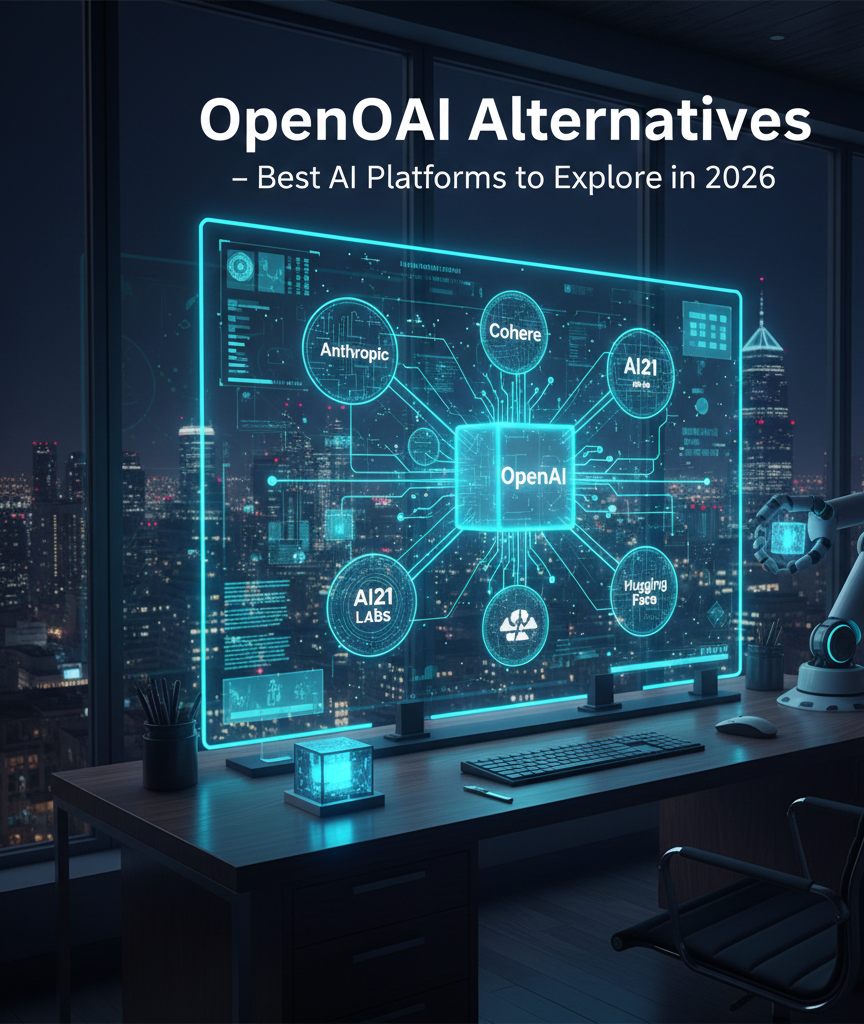
These alternatives allow businesses and developers to experiment, customize, and scale AI solutions without being tied exclusively to OpenAI’s ecosystem. They range from enterprise-grade AI platforms like Anthropic and Cohere to open-source projects like Hugging Face and Mistral AI, providing flexibility for different use cases.
Reasons to Consider OpenAI Alternatives
- Cost Efficiency: OpenAI subscription models or API usage fees can be expensive for small businesses or startups. Alternatives often offer free tiers or lower pricing structures.
- Feature Specialization: Some platforms specialize in certain AI applications, like text summarization, semantic search, or enterprise chatbots, offering capabilities that may surpass OpenAI in specific areas.
- Open-Source and Self-Hosting: Open-source alternatives provide complete control over AI models, allowing customization, private deployment, and integration with proprietary systems.
- Privacy and Data Security: For sensitive industries like healthcare, finance, or legal, alternatives that allow self-hosting or stricter data controls may be preferable.
- Regional Availability or API Access: Some organizations may face API restrictions with OpenAI, so exploring alternatives ensures uninterrupted access to AI services.
Example: A startup focused on AI content creation may choose AI21 Labs or Cohere for their specialized NLP APIs and cost-effective plans, while a research team might prefer Hugging Face or Mistral AI for open-source, fully customizable models.
Top OpenAI Alternatives in 2026
There are several OpenAI alternatives available in 2026, each offering unique features, pricing models, and capabilities. Whether you’re a developer, a business, or a researcher, understanding these alternatives helps you pick the best platform for your needs. Below, we’ll explore the most popular and effective options currently shaping the AI landscape.
Anthropic – AI Safety and Alignment Focused
Overview: Anthropic is a cutting-edge AI company focused on creating safe and reliable AI systems. Their Claude AI models are designed with a “safety-first” philosophy, emphasizing alignment and ethical AI usage.
Features:
- Advanced conversational AI for chatbots
- Natural language understanding and generation
- Enterprise-grade NLP solutions
Best Use Cases:
- Customer support automation
- Enterprise chat solutions
- Ethical AI applications
Pros:
- Strong focus on AI safety and alignment
- Easy-to-integrate APIs for businesses
- Scalable for enterprise deployments
Cons:
- Limited free access for smaller projects
- Fewer third-party integrations compared to OpenAI
Cohere – NLP and Language Models
Overview: Cohere specializes in natural language processing for businesses and developers, offering APIs for text generation, semantic search, and embeddings.
Features:
- Large language models optimized for NLP tasks
- Embedding APIs for search and recommendation systems
- Custom model training for specific use cases
Best Use Cases:
- AI-driven search engines
- Content recommendation systems
- Enterprise automation
Pros:
- Highly accurate NLP performance
- Flexible API for developers
- Custom model training options
Cons:
- Slightly higher cost for large-scale projects
- Limited creative content generation compared to generative AI models
AI21 Labs – Advanced Text Generation
Overview: AI21 Labs provides advanced AI language models like Jurassic-2, specializing in high-quality text generation for writing assistants and content creation tools.
Features:
- Human-like content generation
- Summarization and rewriting tools
- Customizable AI writing workflows
Best Use Cases:
- Marketing content creation
- Blog and article generation
- Academic and professional writing tools
Pros:
- Superior content generation capabilities
- Easy-to-use APIs for developers and writers
- Multiple pricing tiers, including free access
Cons:
- Not ideal for non-text AI applications
- Slightly less enterprise focus than OpenAI
Mistral AI – Open-Weight Models
Overview: Mistral AI is an open-source platform offering fully open-weight AI models, allowing complete customization for developers and researchers.
Features:
- Free and self-hosted model options
- High flexibility and customization
- Suitable for research and experimental projects
Best Use Cases:
- AI research projects
- Custom NLP and generative applications
- Private deployments for sensitive data
Pros:
- Fully open-source
- Highly customizable
- Strong community support
Cons:
- Requires technical expertise to deploy
- Limited managed services or enterprise support
Google DeepMind / Gemini AI
Overview: Google DeepMind’s Gemini AI offers advanced AI models for chat, code generation, and analytics, integrated with Google Cloud’s infrastructure.
Features:
- Enterprise-ready AI solutions
- Multimodal AI capabilities (text, code, data)
- Integration with Google Cloud services
Best Use Cases:
- Large-scale enterprise AI applications
- Data analysis and research
- Automated code generation and workflow optimization
Pros:
- Enterprise-grade reliability
- Seamless integration with cloud services
- Strong AI performance and scalability
Cons:
- Pricing may be high for small businesses
- Primarily cloud-dependent
Microsoft Azure AI Services
Overview: Microsoft Azure AI provides a range of AI services powered by OpenAI models but with enterprise-level support and integrations.
Features:
- Chatbots, NLP, and AI analytics
- Cloud-based deployment with enterprise security
- Integration with Microsoft 365 and Power Platform
Best Use Cases:
- Enterprise AI solutions
- Customer service automation
- Business analytics and insights
Pros:
- Enterprise-grade security and support
- Reliable cloud infrastructure
- Extensive integration with Microsoft ecosystem
Cons:
- Limited flexibility compared to open-source models
- Higher cost for smaller-scale projects
Open-Source AI Alternatives (Hugging Face, LLaMA, Falcon)
Overview: Open-source AI platforms provide fully customizable models for developers, researchers, and startups. Popular options include Hugging Face Transformers, Meta’s LLaMA, and Falcon models.
Features:
- Free or low-cost AI models
- Custom training and deployment
- Large community support and documentation
Best Use Cases:
- Research projects and experimental AI applications
- Startups needing customizable AI solutions
- Private deployments for sensitive data
Pros:
- Cost-effective and flexible
- Full control over AI models and data
- Strong developer communities
Cons:
- Requires technical knowledge to deploy
- Limited managed support compared to enterprise solutions
How to Choose the Right OpenAI Alternative
With so many OpenAI alternatives available in 2026, selecting the right platform can be overwhelming. The best choice depends on your specific use case, technical requirements, budget, and long-term goals. Here’s a comprehensive guide to help you make an informed decision.
Key Factors to Consider
- Features and Capabilities
- Determine what AI functionalities you need: text generation, NLP, embeddings, code generation, multimodal AI, or analytics.
- Ensure the platform supports your intended applications, such as chatbots, content creation, or enterprise analytics.
- Pricing and Subscription Models
- Compare free tiers, pay-per-use, and subscription plans.
- Consider scalability costs if your usage increases over time.
- Example: AI21 Labs offers free access for small projects, whereas enterprise use may require a paid subscription.
- Data Privacy and Security
- If your AI handles sensitive or proprietary data, consider self-hosted or open-source alternatives like Mistral AI or Hugging Face.
- Check if the platform complies with GDPR, HIPAA, or other relevant regulations.
- Ease of Integration
- Evaluate API documentation, SDKs, and existing integrations.
- Ensure the platform can seamlessly integrate with your applications, workflows, or cloud services.
- Support and Community
- Look for platforms with strong developer communities or enterprise support.
- Open-source alternatives may have active forums but limited direct customer support.
- Scalability and Reliability
- Ensure the platform can handle increasing workloads without performance issues.
- Enterprise-grade alternatives like Microsoft Azure AI or Google DeepMind’s Gemini offer robust infrastructure and uptime guarantees.
Questions to Ask Before Choosing an Alternative
- Do I need a hosted solution or full control via self-hosting?
- Is the platform optimized for my industry or specific AI applications?
- How does pricing scale with increased usage?
- What level of technical expertise is required for deployment?
- Does the platform provide reliable support and updates?
Case Studies and Examples of OpenAI Alternatives in Action
Understanding real-world applications of OpenAI alternatives can help you see how businesses and developers leverage these platforms effectively. Below are examples across different industries and use cases.
AI21 Labs – Content Generation for Marketing Agencies
Case Study: A digital marketing agency adopted AI21 Labs’ Jurassic-2 model to automate blog post creation and social media content.
Results:
- Reduced content creation time by 50%
- Improved engagement rates with AI-optimized copy
- Lowered dependency on freelance writers, saving significant costs
Takeaway: AI21 Labs is ideal for teams that require high-quality text generation with minimal human intervention.
Anthropic – Enterprise Chatbots for Customer Support
Case Study: A global e-commerce company integrated Claude AI from Anthropic into its customer support system.
Results:
- Handled 30% more customer queries without increasing staff
- Reduced average response time from 15 minutes to under 3 minutes
- Increased customer satisfaction scores by 20%
Takeaway: Anthropic’s focus on safe and aligned AI makes it suitable for enterprises needing reliable chatbots.
Hugging Face – NLP Models for Research and Custom AI Solutions
Case Study: A research lab used Hugging Face Transformers to analyze large datasets of scientific publications.
Results:
- Automated extraction of key insights from thousands of papers
- Accelerated research timeline by 6 months
- Enabled creation of a custom recommendation system for scientists
Takeaway: Hugging Face is ideal for organizations needing flexible, open-source AI models for specialized research and development projects.
Mistral AI – Custom AI Deployment for Startups
Case Study: A startup in the fintech industry implemented Mistral AI for automated financial report generation and predictive analytics.
Results:
- Full control over AI models and sensitive financial data
- Reduced reporting time by 40%
- Enabled scalable, private AI solutions without relying on cloud providers
Takeaway: Mistral AI is perfect for businesses that require self-hosted, highly customizable AI solutions.
Google DeepMind / Gemini – Enterprise Analytics
Case Study: A logistics company integrated Gemini AI into its supply chain management system.
Results:
- Optimized delivery routes and reduced operational costs by 15%
- Predicted maintenance issues for fleet vehicles in advance
- Improved overall operational efficiency and decision-making
Takeaway: Google’s AI solutions are ideal for large enterprises that need reliable, high-performance AI integrated with existing cloud infrastructure.