
Introduction: Understanding Generative AI and Its Impact
Generative AI has emerged as one of the most transformative technologies of the 21st century, revolutionizing the way humans interact with machines and how content is created. At its core, Generative AI refers to a class of artificial intelligence systems that can produce original content—be it text, images, music, or even videos—based on patterns learned from large datasets. Unlike traditional AI, which is designed to analyze data or perform specific tasks, generative AI actively creates new, innovative outputs, often indistinguishable from human-made content.
The rise of AI content generation has profound implications for industries ranging from marketing and entertainment to healthcare and research. For instance, businesses are leveraging AI tools to produce compelling articles, social media content, and even personalized advertising, dramatically reducing costs and production time. Similarly, in creative fields like digital art and music, generative AI is opening doors to novel forms of expression, allowing artists to collaborate with AI systems to bring their visions to life in ways previously unimaginable.
But what makes generative AI particularly fascinating is its ability to learn from vast amounts of data and generate outputs that are contextually relevant and creative. Modern generative AI models, such as OpenAI’s GPT (Generative Pre-trained Transformer) series, can write essays, answer complex questions, summarize content, and even produce computer code. On the visual front, models like DALL-E and MidJourney can transform textual prompts into stunning, highly detailed images, showcasing the breadth of possibilities that generative AI offers.
In this article, we will dive deep into the world of Generative AI, exploring how it works, its various types, applications, benefits, challenges, and the future of this groundbreaking technology. Whether you are a developer, entrepreneur, or curious learner, this guide aims to provide a complete understanding of AI-driven content creation, helping you navigate the rapidly evolving landscape of generative artificial intelligence.
1. Understanding Generative AI
Generative AI is more than just a buzzword in technology; it represents a paradigm shift in how machines learn, reason, and create. At its essence, Generative AI refers to AI systems capable of producing new content from learned patterns in existing data. These outputs can be textual, visual, audio, or even video-based, often indistinguishable from content created by humans. This ability makes generative AI a powerful tool for creativity, problem-solving, and automation across multiple industries.http://openbygpt.com/
What is Generative AI?
Generative AI is a subset of artificial intelligence that focuses on generating new data rather than simply analyzing or classifying existing data. Traditional AI models are typically predictive—they learn patterns to make decisions or classify inputs. Generative AI, on the other hand, goes a step further by using those patterns to create something entirely new.
For example, OpenAI’s GPT (Generative Pre-trained Transformer) can write coherent essays, answer questions, or even generate computer code. Similarly, DALL-E can convert a textual description into a unique, realistic image. In essence, generative AI models learn the underlying structure of data and use that knowledge to simulate creativity.
Key takeaway: Generative AI is not just about automation—it’s about innovation, enabling machines to produce content that mirrors human creativity.
How Generative AI Works
At the core of generative AI are advanced machine learning techniques such as deep learning and neural networks. These models are trained on massive datasets to learn patterns, structures, and relationships in data. Once trained, they can generate new content by predicting what comes next in a sequence—whether that sequence is words, pixels, or musical notes.
Steps involved in generative AI content creation:
- Data Collection – Large datasets of text, images, audio, or video are collected.
- Model Training – Neural networks learn patterns and correlations in the data.
- Content Generation – The trained model produces new content based on user input or prompts.
- Evaluation and Refinement – Outputs are refined for accuracy, creativity, and relevance.
Example:
- GPT-4, a leading generative AI model, has been trained on trillions of words to understand language structure, context, and semantics. When given a prompt, it can generate paragraphs of human-like text, summarize documents, or even simulate conversation.
Types of Generative AI
Generative AI comes in various forms, each tailored to specific types of content creation:
- Text-Based Generative AI
- Examples: GPT-4, Jasper AI, Copy.ai
- Applications: Blogging, marketing copy, code generation, chatbots
- Image Generation AI
- Examples: DALL-E, MidJourney, Stable Diffusion
- Applications: Digital art, graphic design, marketing visuals
- Audio and Music Generation AI
- Examples: Jukebox AI, OpenAI Audio models
- Applications: AI-composed music, voice synthesis, podcasts
- Video Generation AI
- Examples: Runway ML, Pictory AI
- Applications: Short films, video ads, deepfake technology
- Emerging Types
- 3D object generation, virtual worlds, interactive storytelling
- These areas are still developing but have enormous potential in gaming, simulation, and immersive experiences
Key insight: By understanding the different types of generative AI, businesses and creators can identify the right tools and approaches to enhance productivity, creativity, and innovation.
2. Applications of Generative AI
Generative AI has moved beyond research labs and is now actively transforming industries across the globe. Its ability to create high-quality content, simulate scenarios, and enhance productivity has made it a valuable tool for businesses, creatives, and researchers alike. In this section, we’ll explore the main applications of generative AI and how organizations are leveraging it for real-world solutions.
Content Creation
One of the most widespread applications of generative AI is in content creation. Businesses and individuals use AI to produce written content, marketing copy, and social media posts with impressive speed and accuracy.
- Blogging and Articles: Tools like GPT-4, Jasper AI, and Copy.ai can write long-form content, summaries, and SEO-optimized articles. For example, companies in digital marketing often generate hundreds of blog posts monthly using AI-assisted writing.
- Email Campaigns: AI can personalize email content based on user behavior and engagement patterns, improving open rates and conversion.
- Social Media Posts: Generative AI can create captions, hashtags, and even images for social platforms, saving time for marketing teams.
Fact: According to a 2024 report by MarketsandMarkets, the AI content generation market is expected to reach $1.4 billion by 2030, reflecting the growing adoption of these tools.
Art and Design
Generative AI is also revolutionizing the creative industry by enabling artists and designers to collaborate with machines.
- Digital Art: Tools like DALL-E and MidJourney can generate detailed artwork from textual prompts. Artists can use AI-generated visuals as a base and refine them further.
- Graphic Design: AI helps create logos, marketing visuals, and product designs rapidly, allowing designers to focus on creative decisions rather than repetitive tasks.
Case Study: An artist using MidJourney AI produced a series of digital illustrations that were later sold as NFTs, demonstrating how AI can expand creative and commercial opportunities.
Business and Enterprise Solutions
Generative AI is increasingly adopted in enterprises to automate workflows, analyze data, and enhance decision-making.
- Customer Service: AI-powered chatbots like ChatGPT can handle complex queries, provide 24/7 support, and improve user experience.
- Report Generation: Financial, business, and research reports can be auto-generated using AI models, saving countless hours for employees.
- Data Synthesis: AI can generate synthetic datasets for testing models, improving privacy and accelerating research without relying on sensitive real-world data.
Example: Deloitte uses generative AI to automate internal report creation, enabling consultants to focus on strategic decision-making rather than routine documentation.
Entertainment and Media
Generative AI is shaping the entertainment industry by creating content faster and more creatively.
- Music Production: AI models like OpenAI Jukebox can compose songs in different styles, genres, and moods.
- Scriptwriting: AI can generate dialogue, plot ideas, and storylines for films, TV, and video games.
- Video Content: AI tools can produce promotional videos, short films, and even deepfake simulations for storytelling or marketing purposes.
Healthcare and Science
Even in highly technical fields like healthcare and science, generative AI is making a significant impact.
- Medical Imaging: AI can generate detailed images or enhance scans to aid in diagnostics.
- Drug Discovery: Generative models simulate chemical compounds and predict their effects, accelerating research.
- Data Simulation: AI can create synthetic clinical trial data to test hypotheses without putting patients at risk.
Fact: A 2023 study in Nature Medicine found that generative AI-assisted imaging improved diagnostic accuracy by 15% in complex medical cases.
Summary Table: Applications of Generative AI
| Application Area | Use Cases | Key Tools/Examples |
|---|---|---|
| Content Creation | Blogging, SEO, social media, email | GPT-4, Jasper AI, Copy.ai |
| Art and Design | Digital art, logos, NFT creation | DALL-E, MidJourney, Stable Diffusion |
| Business & Enterprise | Customer support, reports, synthetic data | ChatGPT, OpenAI Codex |
| Entertainment & Media | Music, scripts, videos | Jukebox AI, Runway ML |
| Healthcare & Science | Imaging, drug discovery, data simulation | Custom generative models |
3. Benefits of Generative AI
Generative AI offers transformative advantages across industries, making it one of the most powerful tools in today’s technological landscape. From enhancing creativity to improving efficiency, the benefits of generative AI are driving widespread adoption. Here’s a detailed look at its key advantages:
Increased Productivity and Efficiency
One of the most immediate benefits of generative AI is its ability to automate repetitive tasks and reduce the time spent on content creation.
- Writing and Content Production: AI can generate blog posts, product descriptions, and reports in a fraction of the time it would take a human, allowing businesses to scale content production effortlessly.
- Design Automation: Designers can leverage AI to quickly produce visual elements, reducing the time spent on iterative tasks.
- Workflow Optimization: Generative AI can automate internal documentation, summaries, and analysis, freeing employees to focus on high-value tasks.
Fact: Companies using AI for content creation report up to 50% faster production cycles, translating into significant cost savings and faster go-to-market timelines.
Enhancing Creativity
Generative AI is not just about efficiency—it acts as a creative partner for humans.
- Artists can experiment with AI-generated ideas and visuals to inspire new concepts.
- Writers can use AI to brainstorm plot points, character dialogue, or marketing copy.
- Musicians can explore new melodies, harmonies, and arrangements using AI-generated suggestions.
Example: A team of musicians collaborated with OpenAI Jukebox to produce an album where AI composed initial melodies and harmonies, while humans refined the final tracks, blending technology with human artistry.
Cost Reduction in Content Creation
Traditional content creation often involves hiring writers, designers, or researchers. Generative AI significantly reduces these costs by automating portions of the creative process.
- Companies can generate large volumes of content without expanding staff.
- Marketing campaigns, ad copy, and social media posts can be produced efficiently, lowering operational expenses.
- Small businesses can leverage AI tools without significant budget allocations.
Stat: According to Gartner, organizations that adopted AI-assisted content creation tools saved up to 30% on content production costs annually.
Scalability and Consistency
Generative AI allows businesses to scale creative output without sacrificing quality.
- AI models maintain consistency in tone, style, and messaging across all generated content.
- This is especially useful for global brands that need multilingual content at scale.
- It ensures that marketing campaigns, social media posts, and product descriptions adhere to brand guidelines automatically.
Example: A multinational e-commerce company used GPT-powered tools to generate thousands of product descriptions in multiple languages, ensuring consistent brand messaging worldwide.
Supporting Data-Driven Decisions
Generative AI can assist not only in creating content but also in analyzing and synthesizing data for informed decision-making.
- AI can generate reports based on sales data, customer feedback, or research findings.
- Predictive models can simulate market scenarios or outcomes, aiding strategic planning.
- This reduces human error and allows for data-backed decisions at scale.
Summary Table: Benefits of Generative AI
| Benefit | Explanation | Examples |
|---|---|---|
| Productivity & Efficiency | Automates tasks, faster content production | GPT-4, Copy.ai |
| Enhancing Creativity | Acts as a creative partner, inspires new ideas | DALL-E, MidJourney, Jukebox AI |
| Cost Reduction | Lowers operational expenses by automating repetitive tasks | Marketing campaigns, social media content |
| Scalability & Consistency | Generates large-scale content with consistent style and tone | Multilingual product descriptions |
| Data-Driven Decision Support | Generates reports and simulations to support strategic planning | AI-powered analytics tools |
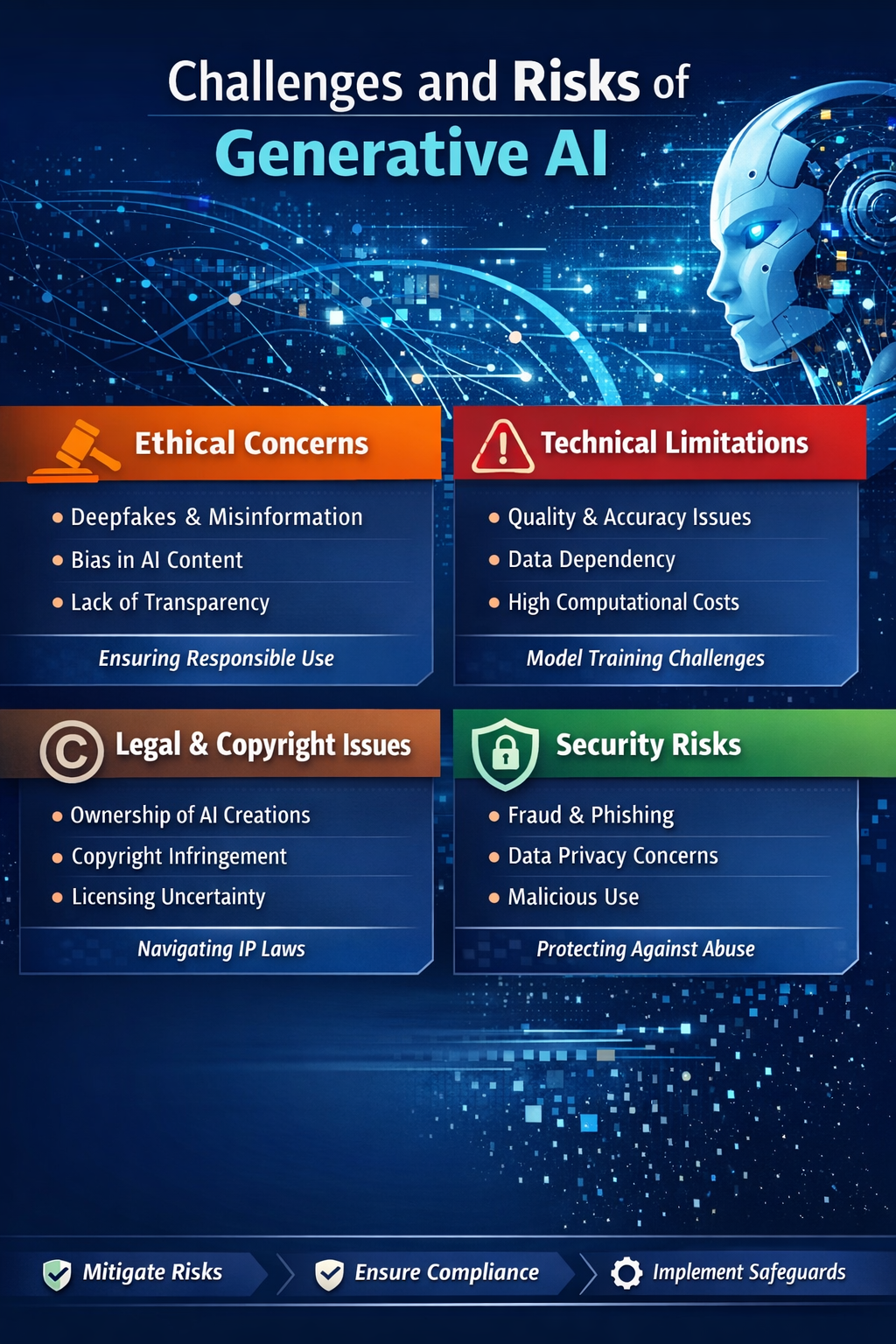
4. Challenges and Risks of Generative AI
While Generative AI offers immense benefits, it is not without challenges. Businesses and creators need to understand the potential risks, ethical concerns, and technical limitations before fully integrating AI into their workflows. This section highlights the major issues associated with generative AI and strategies to mitigate them.
Ethical Concerns
Generative AI raises significant ethical questions, particularly regarding content authenticity and misuse.
- Deepfakes: AI can create realistic images, videos, or audio of individuals, which can be manipulated for misinformation or identity fraud.
- Bias and Discrimination: AI models learn from existing data, which may contain inherent biases. As a result, AI-generated content can inadvertently reflect societal biases, perpetuating stereotypes.
- Misinformation: AI-generated articles or social media posts can spread false information rapidly if unchecked.
Quote: Fei-Fei Li, a leading AI researcher, warns: “AI reflects the data it learns from. If we’re not careful, it can amplify human prejudices and ethical lapses.”
Mitigation:
- Implement bias detection in AI outputs.
- Use AI responsibly with proper oversight and human review.
- Promote transparency about AI-generated content.
Technical Limitations
Generative AI is a powerful tool, but it has inherent technical constraints:
- Quality Issues: AI-generated content may lack factual accuracy, context, or relevance. For example, GPT might produce plausible but incorrect answers in research reports.
- Data Dependency: Generative AI models require massive datasets for training. Poor-quality or insufficient data can lead to unreliable outputs.
- Computational Costs: Training and running large models like GPT-4 or DALL-E demand significant computational power and energy.
Fact: OpenAI reports that running GPT-4 costs approximately $0.03 per 1,000 tokens, reflecting the high computational expense for generating complex content.
Legal and Copyright Issues
AI-generated content raises complex legal questions about ownership, copyright, and intellectual property.
- Who owns AI-generated work? Currently, legal frameworks vary, and many countries do not recognize AI as a creator.
- Copyright Infringement: If AI is trained on copyrighted material without permission, generated outputs could violate intellectual property rights.
- Licensing Concerns: Companies must ensure compliance with platform and tool licensing agreements when using AI-generated content commercially.
Example: In 2023, a lawsuit emerged claiming that AI-generated art copied copyrighted images from human artists without proper attribution, highlighting the legal grey areas in AI content ownership.
Security Risks
Generative AI also introduces potential security challenges:
- Fraud and Phishing: AI-generated emails or messages can be highly convincing, increasing the risk of cyberattacks.
- Data Privacy: Training AI models on sensitive or personal data can lead to privacy violations if not properly managed.
- Malicious Use: Bad actors can use generative AI to produce fake content, malware, or misinformation campaigns.
Mitigation:
- Implement strict data governance policies.
- Monitor AI outputs for potential misuse.
- Educate users and employees about AI security risks.
Summary Table: Challenges and Risks of Generative AI
| Risk Category | Description | Mitigation Strategies |
|---|---|---|
| Ethical Concerns | Bias, misinformation, deepfakes | Human review, bias detection, transparency |
| Technical Limitations | Quality issues, data dependency, high computational costs | High-quality data, model optimization |
| Legal & Copyright | Ownership disputes, IP infringement | Licensing compliance, clear usage policies |
| Security Risks | Fraud, privacy violations, malicious content | Data governance, monitoring, user education |
Generative AI’s risks underscore the importance of responsible usage, legal compliance, and ethical safeguards. While the technology has enormous potential, businesses and individuals must navigate these challenges carefully.