
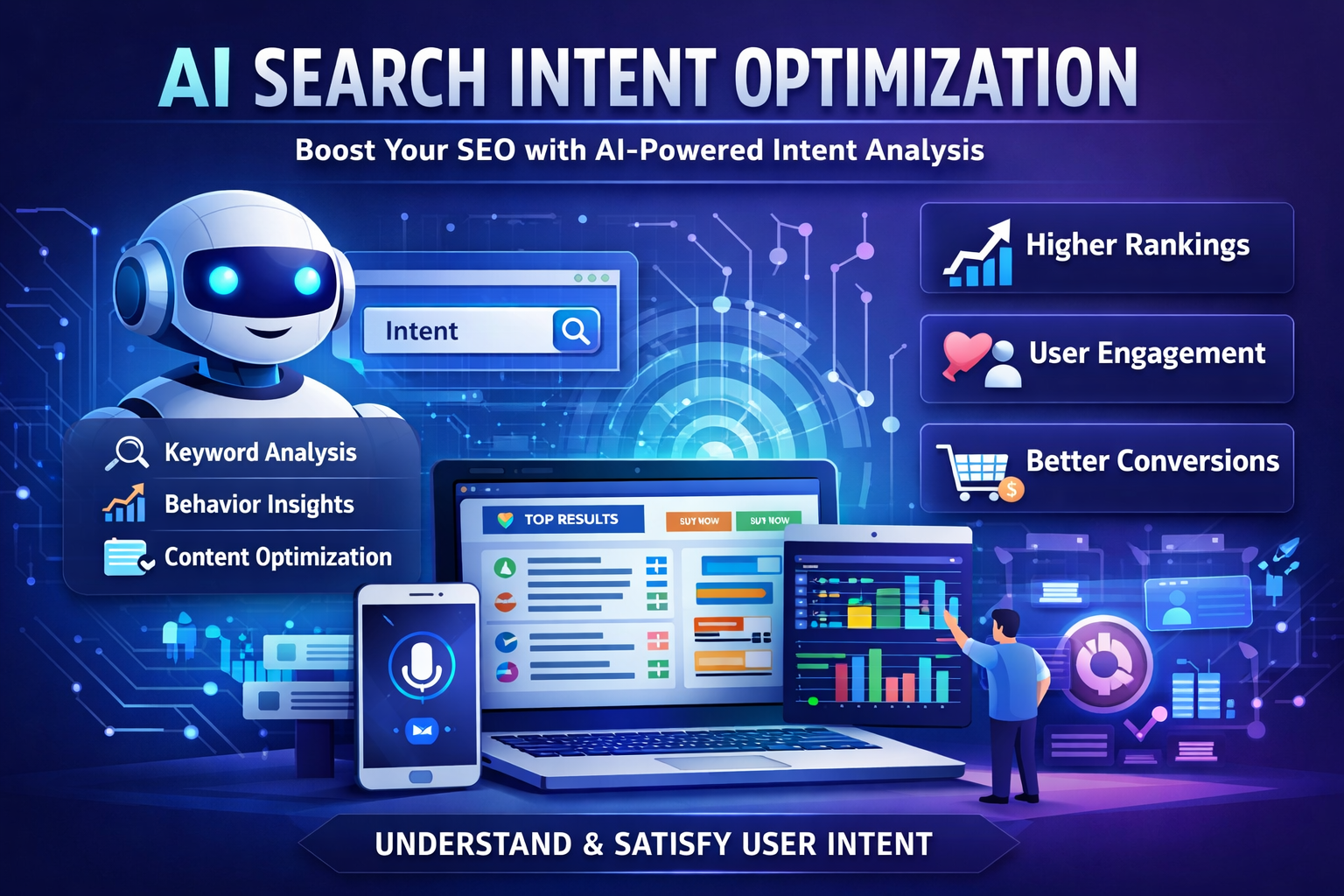
What is AI Search Intent Optimization?
AI Search Intent Optimization is about understanding what users really want when they search online and tailoring your content to meet that need. Unlike traditional SEO, which often focuses solely on keywords, this approach goes deeper: it looks at the purpose behind each search. Whether users are seeking information, a product, a comparison, or a specific website, your content is designed to satisfy that intent.
With the rise of AI-driven search algorithms like Google’s BERT and MUM, search engines now interpret context and meaning, not just exact words. AI tools allow marketers to analyze search behavior, query patterns, and user engagement at scale, helping predict intent and adjust content strategies effectively.
Why it matters for businesses:
- Better visibility: Content that meets user intent ranks higher in search results.
- Improved engagement: Visitors spend more time on pages that fulfill their needs.
- Higher conversions: Intent-aligned content drives more sign-ups, purchases, and interactions.
Example:
A user searches for “best laptops for students 2026.” Traditional SEO might focus on using the keyword repeatedly. AI-driven optimization, however, interprets the query’s context: the user wants recommendations, features, prices, and comparisons relevant to students. The content will include comparison tables, pros and cons, and actionable advice to satisfy this intent.
Types of Search Intent and How AI Detects Them
Understanding search intent is the foundation of effective optimization. Users search online for different reasons, which can be broadly categorized into four types. AI can detect these differences and help tailor content accordingly.
Informational Intent
Users with informational intent are looking to learn or answer questions.
Examples:
- “What is AI search intent optimization?”
- “Best SEO practices in 2026”
How AI helps:
- Suggests related questions and topics
- Generates content outlines that match user learning goals
- Optimizes headings for clarity and relevance
Navigational Intent
Users with navigational intent want to reach a specific website or brand.
Examples:
- “HubSpot SEO blog”
- “OpenAI ChatGPT login”
How AI helps:
- Improves brand visibility in search results
- Optimizes metadata and site structure for branded searches
Transactional Intent
Transactional searches show that the user is ready to take action, like buying or subscribing.
Examples:
- “Buy AI SEO tool”
- “Subscribe to AI content platform”
How AI helps:
- Suggests product-focused content with clear CTAs
- Creates optimized landing pages
- Personalizes offers based on behavior patterns
Commercial Investigation Intent
Users with commercial investigation intent are researching options before buying.
Examples:
- “Best AI SEO tools 2026”
- “MarketMuse vs Surfer SEO review”
How AI helps:
- Generates comparison tables, pros/cons lists, and rankings
- Suggests internal links to related product pages
- Highlights trending features or updates in the market
Summary Table: Types of Search Intent and AI Role
| Intent Type | User Goal | AI Optimization Role | Example Queries |
|---|---|---|---|
| Informational | Learn something | Suggest topics, optimize headings | “What is AI search intent optimization?” |
| Navigational | Visit a brand/website | Improve metadata, SERP visibility | “HubSpot SEO blog” |
| Transactional | Make a purchase | Optimize landing pages, CTAs | “Buy AI SEO tool” |
| Commercial Investigation | Compare options | Generate comparisons, rankings | “MarketMuse vs Surfer SEO” |
How AI Analyzes Search Intent
AI enables a deeper understanding of queries, going beyond keywords to the actual meaning behind them. Here’s how it works:
Machine Learning (ML)
ML models analyze millions of queries, click patterns, and user behavior to predict intent. This helps detect:
- Tutorial or how-to searches
- Subtle differences between similar queries
- Long-tail queries indicating specific needs
Natural Language Processing (NLP)
NLP allows AI to understand human language, recognizing context, synonyms, and sentiment. It interprets the meaning of queries like:
- “Best AI tools for SEO 2026” → indicates research/comparison intent
- Tools like BERT and MUM analyze both query and content to match relevance
Predictive Analytics
AI can anticipate trends and predict what users might search next. This enables:
- Identifying emerging topics before competitors
- Filling content gaps
- Suggesting internal links to guide users along the conversion path
Example: Users searching “AI SEO tools” often next search for “AI content optimization tips.” AI can recommend content bridging these topics for higher engagement.
Popular AI Tools for Intent Analysis
| Tool | Purpose | How It Helps |
|---|---|---|
| MarketMuse | Content research | Identifies gaps and aligns content with intent |
| Surfer SEO | On-page optimization | Suggests keywords, headings, and structure |
| Clearscope | Semantic relevance | Suggests related terms for completeness |
| ChatGPT | Content generation | Drafts outlines, FAQs, and topic ideas |
| SEMrush | Keyword intent classification | Labels keywords as informational, transactional, etc. |
Benefits of AI Search Intent Optimization
Optimizing content for search intent brings measurable results.
Higher Organic Traffic
AI ensures content aligns with user queries, helping it rank higher. Studies show pages optimized for intent can see up to 30% more organic traffic compared to keyword-focused content.
Improved Engagement
Content that satisfies intent reduces bounce rates and increases dwell time. AI helps by:
- Suggesting structure that matches search goals
- Optimizing readability with headings, lists, and visuals
Higher Conversion Rates
Transactional and commercial investigation intent content directly drives action:
- Identifies purchase-ready keywords
- Suggests CTAs and internal links
- Example: A software company increased conversions by 42% after optimizing product pages for intent-driven queries.
Efficient Content Strategy
AI helps focus on high-value topics, saving time:
- Recommends low-competition, high-intent keywords
- Suggests related subtopics and semantic keywords
- Scores content for relevance before publishing
Summary Table: Benefits
| Benefit | AI Role | Impact |
|---|---|---|
| Higher traffic | Aligns content with queries | More visibility |
| Improved engagement | Optimized structure & readability | Lower bounce rate |
| Higher conversions | Targets transactional intent | Increased sign-ups/sales |
| Efficient strategy | Data-driven recommendations | Saves time, improves ROI |
Step-by-Step Guide to AI Search Intent Optimization
- Keyword Research with Intent
Identify keywords by intent type (informational, transactional, commercial). Cluster related terms and prioritize long-tail queries. - Analyze Top SERPs
Study top-ranking pages to understand how competitors satisfy intent. Identify content gaps and opportunities. - Optimize Existing Content
Update headings, meta descriptions, and structure to match intent. Add FAQs, tables, or visuals where needed. - Create New Intent-Focused Content
Draft content specifically for each intent type. Use structured headings, comparison tables, and actionable advice. - Continuous Monitoring
Track CTR, dwell time, bounce rate, and conversions. Update content as user intent evolves.
AI Tools for Search Intent Optimization
- MarketMuse: Content research and gap analysis
- Surfer SEO: On-page optimization
- Clearscope: Semantic content relevance
- ChatGPT: Drafting content, FAQs, outlines
- SEMrush: Keyword intent classification
Combining tools often yields the best results.
Common Mistakes to Avoid
- Keyword stuffing: Use keywords naturally; focus on value
- Ignoring long-tail queries: Target high-intent searches
- Over-reliance on AI: Always review content for accuracy and tone
- Not updating content: Regularly refresh content to match evolving intent
Measuring Success
Track these metrics:
- Organic traffic and CTR
- Bounce rate and dwell time
- Conversion rates
- Content relevance using AI tools
Regular monitoring ensures your strategy stays effective.
The Future of AI and Search Intent
- Generative AI: Creates intent-aligned content at scale
- Voice search optimization: Natural language queries require structured answers
- Personalization: AI predicts content users are most likely to engage with
- Continuous algorithm evolution: Early adoption ensures competitive advantage
FAQs
Q: How is AI SEO different from traditional SEO?
A: AI SEO focuses on intent and engagement, not just keywords.
Q: Can AI fully understand intent without humans?
A: No. Human oversight ensures accuracy, relevance, and brand alignment.
Q: How often should content be updated?
A: Every 3–6 months or when user intent changes.
Q: Are there free AI tools?
A: Yes – ChatGPT, Google Search Console, AnswerThePublic, Ubersuggest.
Q: How does AI help with voice search?
A: AI optimizes content for conversational queries, FAQs, and structured answers.